Sunday, January 19, 2014

Goldilocks Belt


In astronomy and astrobiology, the circumstellar habitable zone (CHZ) (or simply the habitable zone), colloquially known as the Goldilocks zone, is the region around a star within which planetary-mass objects with sufficient atmospheric pressure can support liquid water at their surfaces.The bounds of the CHZ are calculated using the known requirements of Earth's biosphere, its position in the Solar System and the amount of radiant energy it receives from the Sun. Due to the importance of liquid water to life as it exists on Earth, the nature of the CHZ and the objects within is believed to be instrumental in determining the scope and distribution of extraterrestrial life and intelligence.

Now that we have explored Earth, Venus and Mars in some detail, it is very tempting to conclude that Venus is too close to the Sun so it is too hot for life as we know it. Mars is too far away from the Sun so it is too cold, and, as the Goldilocks fairytale goes, Earth is just the right distance from our Sun, neither too hot nor too cold to support life. This is the essence of the concept of the Goldilocks Zone, a specific distance from a star in which a planet receives just enough energy to support liquid water on its surface, and thus, life.
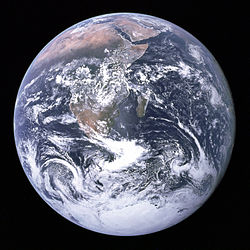

However, if we think about these three planets for a moment, we might notice some complications to this idea. First of all, of these planets, only Earth has a significant magnetic field that protects its atmosphere from solar wind. Why? It is this atmosphere that moderates Earth’s temperatures and allows liquid water to exist, between 0°C and 100°C. On Mars, with no magnetic field, any atmosphere that may have once existed has been stripped away over the eons by solar winds. Its surface is now ravaged by ultraviolet and other solar radiation. Earth is also the only planet that exhibits plate tectonics and this means that nutrients and gases can cycle into different forms, keeping their atmospheric concentrations buffered within certain extremes. For example, carbon dioxide is moderated by the carbon cycle on Earth and this prevents a runaway greenhouse effect, which seems to have occurred on Venus, sending its surface temperatures skyrocketing up to about 460°C.

Does distance from the Sun have anything to do with internally created core dynamos or plate tectonic movement? Does how a planet form impact its later habitability? Do catastrophic events early on in a planet’s life affect its later habitability as much or more than its distance from its star? For example, did Earth’s surface water come from within Earth or did it come from comet impacts during the Heavy Late Bombardment? Let’s see what the Goldilocks Zone theory has to offer in terms of answering these questions.

What the Goldilocks Zone Is

The Goldilocks Zone or habitable zone is, technically, the intersection of two regions in space that must both be favourable to life. One region is confined to the planetary system of interest and the other region is where this system exists within its galaxy. The zone around a star, also called the circumstellar habitable zone or ecosphere, is where the star’s energy output allows for water to exist as a liquid rather than freezing or boiling away. The galactic habitable zone is a hypothesis that is met with a bit more skepticism than the ecosphere zone. The idea here is that the center of the universe acts in much the same way as a star does in the ecosphere zone. The favourable zone must exist close enough to gather enough heavy elements to form a habitable planet but far enough away to be protected from radiation from the galactic centre. Planets or moons could exist within this intersected region and possibly support carbon-based life. However, it is important to remember that planets within the Goldilocks Zone may not all be habitable. For example, gas giants in this zone are unlikely to support life.

The Goldilocks Planets Of Gliese 581

The red dwarf star, Gliese 581, is of particular interest to scientists studying Goldilocks planets because it has a planetary system and one planet in particular, that lie within the Goldilocks Zone. 


You can see that both Earth and Mars are within the Goldilocks Zone with Venus just on the inner edge of it. Gliese 581 g exists well within the habitable zone around its star, with Gliese 581 c and Gliese 581 d straddling the zone. Scientists currently hold all three exoplanets as possibly life-supporting, with reservations. Gliese 581 g appears to be a perfect candidate for alien life. However, recent evidence indicates that it may be tidally locked, meaning that one side always faces its star. And I should also note that both planets g and f are listed as unconfirmed because they have not been detected by new spectrograph analysis. In both solar systems, planets such as Gliese 581 f and Jupiter do not receive enough solar radiation to make up for radiative losses, and surface water freezes. Planets such as Gliese 581 e and Mercury, on the other hand, absorb too much solar radiation and any surface water simply boils away. Keep in mind that the Goldilocks Zone must be calculated for each star system based on the energy output of that star. The Goldilocks Zone for Gliese 581 is much closer to the star than our Sun’s habitable zone. Gliese 581 has only 0.2% of the visual luminosity of our Sun (but while our Sun radiates mostly in the visible spectrum, Gliese 581 radiates mostly in the near infrared, meaning that although it is much fainter than the Sun it gives off a much higher percentage of its radiation as heat than the Sun does). This NASA image gives you an idea of how the Goldilocks Zone (shown as a green belt) is affected by the host star’s energy output.


Kepler Space Mission Results

The Kepler Space Observatory launched by NASA in 2009 is designed to discover Earth-like planets orbiting within the habitable zones of other stars in the Milky Way galaxy. This is Kepler’s targeted star field, only 1/400th of the night sky, courtesy of NASA.


We do not yet have the capacity to directly observe these planets but we can detect them indirectly by monitoring fluctuations in brightness of other main sequence stars. Fluctuations in brightness indicate one or more planets and/or moons crossing the star’s surface. This NASA image shows how this works.


In February 2011, the Kepler Space Observatory Mission Team released a list of 1235 possible exoplanets, with 54 of them being both Earthlike in size and existing within the Goldilocks Zone. This 10 - minute NASA video introduces us to the Kepler Mission.


This is a very exciting time for astronomy. These results have allowed scientists to estimate for the first time that about 6% of all stars host Earth-size planets and 19% of all stars host multiple planets. Astronomer Seth Shostak believes that, based on the Kepler findings, there are at least 30,000 habitable worlds within a thousand light years of Earth!

New Missions To Study Goldilocks Planets?

We need to confirm the existence of the Kepler Mission exoplanets and to study them in more detail and for that we will need a new generation of observational missions tailored to study exoplanets. Several such missions have been proposed and await funding. The Darwin, a European Space Agency cornerstone mission, was proposed but scrapped in 2007, because of technical and funding problems. It would have detected exoplanets and then carried out more detailed analysis of their atmospheres, looking specifically for the presence of oxygen. Finding just atomic oxygen does not necessarily mean life, however. Europa, one of Jupiter’s moons, has a tenuous oxygen atmosphere that is produced by the radiolysis of water molecules (this means that solar radiation breaks water molecules into ionized atoms) high up in its atmosphere. To find oxygen produced biologically through some kind of photosynthesis-like process, astronomers must look for the simultaneous presence of ozone, water and carbon dioxide. Oxygen produced at high altitude as it is on Europa immediately attacks atmospheric ozone and prevents its accumulation. If oxygen is produced low in the atmosphere, say through photosynthesis, and little water gets high into the atmosphere, then there are no ions that can attack ozone. Therefore, scientists now believe that ozone, water and carbon dioxide (required for photosynthesis) along with oxygen comprise a reliable biosignature in an alien atmosphere. This mission would have looked for this signature, with the Gliese planets being good first candidates for study.

Other missions that have been proposed and scrapped or put on hold include the New Worlds Mission,PLATO, the Space Interferometry Mission, the Terrestrial Planet Finder and the Transiting Exoplanet Survey Satellite, all of which were planned at least in part by NASA except for PLATO, which was another planned European Space Agency mission. Right now, the Kepler Mission, still active, is our best exoplanet explorer and it has been very successful so far. As our technology improves, new missions to study these worlds will undoubtedly be planned and we will move forward in this exciting new field of research.

Goldilocks Zone – A Concept In Infancy

In the meantime, it is important that we refine our search for habitable planets. The Goldilocks Zone concept is in its infancy and it will be refined and expanded upon as we learn more about what makes planets habitable. We are doing that right now as we study the mysteries of Mars, Venus and Earth right here in our own stellar neighbourhood. We also need to question and refine our definition of life itself. As we discover new forms of life never before believed possible in extreme environments right here on Earth, where there is no oxygen or temperatures are well below freezing are well above the boiling point, we must open ourselves to new possible extreme habitats in which life finds a foothold. And we must explore the possibilities of biochemistries that may not be based on carbon or water at all. Why is liquid water so important for life to exist? Carbon compounds dissolve in water to form the basis of all life as we know it, from enzyme functions to the building of cells, tissues and more complex structures. But are other biological solvents possible? A potential biosolvent should exist as a liquid over the range of temperatures an alien organism might encounter, and pressure must be accounted for. For example, while hydrogen cyanide has a very narrow temperature range as a liquid at 1 atmosphere (the surface pressure on Earth), it can exist as a liquid over a wide temperature range on Venus where the surface pressure is almost 100 times greater. Observations from NASA’s Spitzer telescope hint that planets around cool stars such as M-dwarfs and brown dwarfs, which are widespread around the Milky Way, might offer a prebiotic chemical soup that is different from that of our young Earth. The disc chemistry around these cool stars is different from that around our Sun, containing significant amounts of hydrogen cyanide, for example. Hydrogen cyanide is an active molecule that can combine to form adenosine, an essential building block of DNA. Perhaps it could function as a building block in the biochemistry of some kind of alien life, perhaps on a young planet such as the one in this NASA artist’s conception.


Methane, hydrogen fluoride and perhaps even molten salts could also theoretically be used as biosolvents. As well, rather than carbon, life could use silicon atoms. Silicon is chemically similar to carbon and it is far more abundant on rocky planets than carbon is. However it cannot create as many diverse functional groups as carbon can and it can’t readily form the double and triple bonds important to carbon-based biochemistry. But it may be useful under temperatures and pressures different than those of Earth or it could be used in roles less analogous to carbon. These kinds of studies will affect what we refer to as the Goldilocks Zone and perhaps even do away with the concept all together.


Watch Video:

Thursday, January 16, 2014


Comets


A comet is an icy body that releases gas or dust. They are often compared to dirty snowballs, though recent research has led some scientists to call them snowy dirtballs. Comets contain dust, ice, carbon dioxide, ammonia, methane and more. Some researchers think comets might have originally brought some of the water and organic molecules to Earth that now make up life here.
Comets orbit the sun, but most are believed to inhabit in an area known as the Oort Cloud, far beyond the orbit of Pluto. Occasionally a comet streaks through the inner solar system; some do so regularly, some only once every few centuries. Many people have never seen a comet, but those who have won't easily forget the celestial show.
Halley's Comet as photographed May 8, 1910, by Dr. G.W. Ritchey using the 60-inch (1.5-meter) telescope at Mount Wilson Observatory, Calif., during the comet's last appearance. The head of the comet and the beginning of its long tail are shown. Short, str
 The solid nucleus or core of a comet consists mostly of ice and dust coated with dark organic material, with the ice composed mainly of frozen water but perhaps other frozen substances as well, such as ammonia, carbon dioxide, carbon monoxide and methane. The nucleus might have a small rocky core.
As a comet gets closer to the sun, the ice on the surface of the nucleus begins turning into gas, forming a cloud known as the coma. Radiation from the sun pushes dust particles away from the coma, forming a dust tail, while charged particles from the sun convert some of the comet's gases into ions, forming an ion tail. Since comet tails are shaped by sunlight and the solar wind, they always point away from the sun.


The nuclei of most comets are thought to measure 10 miles (16 km) or less. Some comets have comas that can reach nearly 1 million miles (1.6 million kilometers) wide, and some have tails reaching 100 million miles (160 million kilometers) long.
We can see a number of comets with the naked eye when they pass close to the sun because their comas and tails reflect sunlight or even glow because of energy they absorb from the sun. However, most comets are too small or too faint to be seen without a telescope.
Comets leave a trail of debris behind them that can lead to meteor showers on Earth. For instance, the Perseid meteor shower occurs every year between August 9 and 13 when the Earth passes through the orbit of the Swift-Tuttle comet.
Orbital Characteristics
Asteroids classify comets based on the durations of their orbits around the sun. Short-period comets need roughly 200 years or less to complete one orbit, long-period comets take more than 200 years, and single-apparition comets are not bound to the sun, on orbits that take them out of the solar system. Recently, scientist have also discovered comets in the main asteroid belt — these main-belt comets might be a key source of water for the inner terrestrial planets.
Scientists think short-period comets, also known as periodic comets, originate from a disk-shaped band of icy objects known as the Kuiper belt beyond Neptune's orbit, with gravitational interactions with the outer planets dragging these bodies inward, where they become active comets. Long-period comets are thought to come from the nearly spherical Oort cloud even further out, which get slung inward by the gravitational pull of passing stars.
Some comets, called sun-grazers, smash right into the sun or get so close that they break up and evaporate.

Naming
In general, comets are named after their discoverer, either a person. For example, comet Shoemaker-Levy 9 got its name because it was the ninth short-periodic comet discovered by Eugene and Carolyn Shoemaker and David Levy. Spacecraft have proven very effective at spotting comets as well, so the names of many comets incorporate the names of missions such as SOHO or WISE.

Formation
Astronomers think comets are leftovers from the gas, dust, ice and rocks that initially formed the solar system about 4.
6 billion years ago.

Comet Life Cycle
  • Departure
Some comets are not bound to the sun, on orbits that take them out of the solar system.
  • Extinction
Comets lose ice and dust each time they come near the sun, leaving behind trails of debris. Eventually, they can lose all their ices, with some turning into fragile, inactive objects similar to asteroids.
  • Breakup
Other comets, upon losing all their ices, break up and dissipate into clouds of dust.
  • Collisions
The orbits comets take sometimes end with them colliding with planets and their moons. Many impact craters seen in the solar system were caused by such collisions.

History
In antiquity, comets inspired both awe and alarm, "hairy stars" resembling fiery swords that appeared unpredictably in the sky. Often, comets seemed to be omens of doom — the most ancient known mythology, the Babylonian "Epic of Gilgamesh," described fire, brimstone, and flood with the arrival of a comet, and Emperor Nero of Rome saved himself from the "curse of the comet" by having all possible successors to his throne executed. This fear was not just limited to the distant past — in 1910, people in Chicago sealed their windows to protect themselves from what they thought was the comet’s poisonous tail.
For centuries, scientists thought comets traveled in the Earth's atmosphere, but in 1577, observations made by Danish astronomer Tycho Brahe revealed they actually traveled far beyond the moon. Isaac Newton later discovered that comets move in elliptical, oval-shaped orbits around the Sun, and correctly predicted that they could return again and again.
Chinese astronomers kept extensive records on comets for centuries, including observations of Halley's Comet going back to at least 240 BC, historic annals that have proven valuable resources for later astronomers.
A number of recent missions have ventured to comets. NASA's Deep Impact collided an impactor into Comet Tempel 1 in 2005 and recorded the dramatic explosion that revealed the interior composition and structure of the nucleus. In 2009, NASA announced samples the Stardust mission returned from Comet Wild 2 revealed a building block of life. The European Space Agency's Rosetta is scheduled to orbit Comet Churyumov-Gerasimenko in 2014 and deploy a probe to make the first landing on a comet.

Famous Comets
Halley's Comet is likely the most famous comet in the world, even depicted in the Bayeux Tapestry that chronicled the Battle of Hastings of 1066. It becomes visible to the naked eye every 76 years when it nears the sun. When Halley's Comet zoomed near Earth in 1986, five spacecraft flew past it and gathered unprecedented details, coming close enough to study its  nucleus, which is normally concealed by the comet's coma. The roughly potato-shaped, nine-mile-long (15 km) contains equal part ice and dust, with some 80 percent of the ice made of water and about 15 percent of it consisting of frozen carbon monoxide. Researchers believe other comets are chemically similar to Halley's Comet. The nucleus of Halley's Comet was unexpectedly extremely dark black — its surface, and perhaps those of most others, is apparently covered with a black crust of dust over most of the ice, and it only releases gas when holes in this crust expose ice to the sun.
The comet Shoemaker-Levy 9 collided spectacularly with Jupiter in 1994, with the giant planet's gravitational pull ripping the comet apart for at least 21 visible impacts. The largest collision created a fireball that rose about 1,800 miles (3,000 km) above the Jovian cloud-tops as well as a giant dark spot more than 7,460 miles (12,000 km) across — about the size of the Earth —and was estimated to have exploded with the force of 6,000 gigatons of TNT.
A recent, highly visible comet was Hale-Bopp, which came within 122 million miles (197 million kilometers) of Earth in 1997. Its unusually large nucleus gave off a great deal of dust and gas — estimated at roughly 18 to 25 miles (30 to 40 kilometers) across — appeared bright to the naked eye.
When Earth crosses the path of a comet, even if the comet hasn't been around for a few years, leftover dust and ice can create increased numbers of meteors in what's known as a meteor shower.

10 Need-to-Know Things About Comets:

  1. If the sun were as tall as a typical front door, Earth would be the size of a nickel, dwarf planet Pluto would be the size of a head of a pin and the largest Kuiper Belt comet (about 100 km across, which is about one twentieth the size of Pluto) would only be about the size of a grain of dust.
    Link to Rosetta mission to a comet


  2. Short-period comets (comets that orbit the sun in less than 200 years) reside in the icy region known as the Kuiper Belt beyond the orbit of Neptune from about 30 to 55 AU. Long-period comets (comets with long, unpredictable orbits) originate in the far-off reaches of the Oort Cloud, which is five thousand to 100 thousand AUs from the sun.
  3. Days on comets vary. One day on comet Halley varies between 2.2 to 7.4 Earth days (the time it takes for comet Halley to rotate or spin once). Comet Halley makes a complete orbit around the sun (a year in this comet's time) in 76 Earth years.
  4. Comets are cosmic snowballs of frozen gases, rock and dust.
  5. A comet warms up as it nears the sun and develops an atmosphere, or coma. The coma may be hundreds of thousands of kilometers in diameter.
  6. Comets do not have moons.
  7. Comets do not have rings.
  8. More than 20 missions have explored comets from a variety of viewpoints.
  9. Comets may not be able to support life themselves, but they may have brought water and organic compounds -- the building blocks of life -- through collisions with Earth and other bodies in our solar system.
  10. Comet Halley makes an appearance in the Bayeux Tapestry from the year 1066, which chronicles the overthrow of King Harold by William the Conqueror at the Battle of Hastings.


Watch video:


Wednesday, January 15, 2014

White Dwarf


When the triple-alpha process in a red giant star is complete, those evolving from stars less than 4 solar masses do not have enough energy to ignite the carbon fusion process. They collapse, moving down and to the left of the main sequence until their collapse is halted by the pressure arising from electron degeneracy. An interesting example of a white dwarf is Sirius-B, shown in comparison with the Earth's size below. The sun is expected to follow the indicated pattern to the white dwarf stage.
1 teaspoon of a white dwarf would weigh 5 tons. A white dwarf with solar mass would be about the size of the Earth.


At left may be a future white dwarf in Helix Nebula. At right is hot white dwarf NGC2440. Both are surrounded by "cocoons" of the gas they ejected in their collapse toward the white dwarf stage.
Another probable future white dwarf can be seen in IC-5148 .


Sirius-B

The white dwarf Sirius-B was not seen until 1862, but was predicted in 1844 from the motion of Sirius-A. The black-body spectrum of Sirius-B peaks at 110 nm, corresponding to a temperature of 26,000 K. From the known absolute magnitude, the radius is calculated to be just 4200 km. Smaller than the Earth, it is almost as massive as the Sun.

Electron Degeneracy

Electron degeneracy is a stellar application of the Pauli Exclusion Principle, as is neutron degeneracy. No two electrons can occupy identical states, even under the pressure of a collapsing star of several solar masses. For stellar masses less than about 1.44 solar masses, the energy from the gravitational collapse is not sufficient to produce the neutrons of a neutron star, so the collapse is halted by electron degeneracy to form white dwarfs. This maximum mass for a white dwarf is called the Chandrasekhar limit. As the star contracts, all the lowest electron energy levels are filled and the electrons are forced into higher and higher energy levels, filling the lowest unoccupied energy levels. This creates an effective pressure which prevents further gravitational collapse.
Sirius-B gives an example of the size of a white dwarf. Electron degeneracy halts the collapse of this star at the white dwarf stage. Though comparable in mass to the Sun, its white dwarf stage is smaller than the Earth.

Sirius-A

The star Sirius, referred to as Sirius-A, is perhaps most notable for the study of the "companion of Sirius" or Sirius-B which was the first example of a white dwarf star to be studied. Sirius itself is one of the brightest stars in the sky, being only 8.6 light-years away from us.
It is also notable for being the subject of one of the first serious studies of the carbon cycle of nuclear fusion. It is much hotter than our Sun and it was clear that some process other than proton-proton fusion was taking place to produce all that energy.

The Chandrasekhar Limit for White Dwarfs

The calculation of the maximum mass of 1.44 solar masses for a white dwarf was done by Subrahmanyan Chandrasekhar on a ship on the way from India to England to begin graduate study in physics at Cambridge University! This initial calculation was done when he was only 20 and carefully refined by the time he was 22! The naming of the limit for its discoverer seems particularly appropriate in light of the intense personal story which surrounds it. Chandrasekhar was interested in the final states of collapsed stars as determined by electron degeneracy and had used the work of Arthur S. Eddington and Ralph H. Fowler to begin his calculations. He realized that they hadn't included relativity in their calculations. When he revised their equations to include relativity, he found that above a certain limit there was no solution. This implied that for masses above 1.44 solar masses there could be no balance between electron degeneracy and the crushing gravitational force and that the star would continue to collapse.
The poignancy of the situation for this young, essentially self-taught, physicist was that Eddington strongly resisted his ideas for years! Eddington's public and vocal opposition made Chandrasekhar's life so difficult that at age 29 he wrote a definitive book on the subject of stellar structure, determined to close that subject and pursue other interests. In the process, he produced a work which defined the subject for years afterward and is regarded as a classic.
To Eddington's credit, he later acknowledged the value and correctness of Chandrasekhar's work as he wrote about the remarkable white dwarf Sirius-B: "The message of the Companion of Sirius when it was decoded ran:'I am composed of material 3,000 times denser than anything you have come across; a ton of my material would be a little nugget that you could put in a matchbox.' What reply can one make to such a message? The reply that most of us made in 1914 was - 'Shut up. Don't talk nonsense.'"
Chandrasekhar himself had no idea what would happen when the limit of 1.44 solar masses was exceeded, except that the star would continue to collapse. Our present understanding is that the collapse will continue until it is stopped by neutron degeneracy with the formation of a neutron star. But even that is not the ultimate limit, since neutron degeneracy can also be overcome by masses greater than 3 solar masses and the ultimate collapse is toward a black hole.


Watch video:

Tuesday, January 14, 2014

Fundamental Forces


As you sit in front of your computer reading this article, you may be unaware of the many forces acting upon you. A force is defined as a push or pull that changes an object's state of motion or causes the object to deform. Newton defined a force as anything that caused an object to accelerate -- F = ma, where F is force, m is mass and a is acceleration.
The familiar force of gravity pulls you down into your seat, toward the Earth's center. You feel it as your weight. Why don't you fall through your seat? Well, another force, electromagnetism, holds the atoms of your seat together, preventing your atoms from intruding on those of your seat. Electromagnetic interactions in your computer monitor are also responsible for generating light that allows you to read the screen.
Gravity and electromagnetism are just two of the four fundamental forces of nature, specifically two that you can observe every day. What are the other two, and how do they affect you if you can't see them?
The remaining two forces work at the atomic level, which we never feel, despite being made of atoms. The strong force holds the nucleus together. Lastly, the weak force is responsible for radioactive decay, specifically, beta decay where a neutron within the nucleus changes into a proton and an electron, which is ejected from the nucleus.
Without these fundamental forces, you and all the other matter in the universe would fall apart and float away. Let's look at each fundamental force, what each does, how it was discovered and how it relates to the others.

Gravity

The first force that you ever became aware of was probably gravity. As a toddler, you had to learn to rise up against it and walk. When you stumbled, you immediately felt gravity bring you back down to the floor. Besides giving toddlers trouble, gravity holds the moon, planets,sun, stars and galaxies together in the universe in their respective orbits. It can work over immense distances and has an infinite range.
Isaac Newton envisioned gravity as a pull between any two objects that was directly related to their masses and inversely related to the square of the distance separating them. His law of gravitation enabled mankind to send astronauts to the moon and robotic probes to the outer reaches of our solar system. From 1687 until the early 20th century, Newton's idea of gravity as a "tug-of-war" between any two objects dominated physics.
But one phenomenon that Newton's theories couldn't explain was the peculiar orbit of Mercury. The orbit itself appeared to rotate (also known as precession). This observation frustrated astronomers since the mid-1800s. In 1915, Albert Einstein realized that Newton's laws of motion and gravity didn't apply to objects in high gravity or at high speeds, like the speed of light.
In his general theory of relativity, Albert Einstein envisioned gravity as a distortion of space caused by mass. Imagine that you place a bowling ball in the middle of a rubber sheet. The ball makes a depression in the sheet (a gravity well or gravity field). If you roll a marble toward the ball, it will fall into the depression (be attracted to the ball) and may even circle the ball (orbit) before it hits. Depending upon the speed of the marble, it may escape the depression and pass the ball, but the depression might alter the marble's path. Gravity fields around massive objects like the sun do the same. Einstein derived Newton's law of gravity from his own theory of relativity and showed that Newton's ideas were a special case of relativity, specifically one applying to weak gravity and low speeds.
When considering massive objects (Earth, stars, galaxies), gravity appears to be the most powerful force. However, when you apply gravity to the atomic level, it has little effect because the masses of subatomic particles are so small. On this level, it's actually downgraded to the weakest force.

Electromagnetism

If you brush your hair several times, your hair may stand on end and be attracted to the brush. Why? The movement of the brush imparts electrical charges to each hair and the identically charged individual hairs repel each other. Similarly, if you place identical poles of two bar magnets together, they will repel each other. But set the opposite poles of the magnets near one another, and the magnets will attract each other. These are familiar examples of electromagnetic force; opposite charges attract, while like charges repel.
Scientists have studied electromagnetism since the 18th century, with several making notable contributions.
  • In 1785, famed French physicist Charles Coulomb described the force of electrically charged objects as directly proportional to the magnitudes of the charges and inversely related to the square of the distances between them. Like gravity, electromagnetism has an infinite range.
  • In 1819, Danish physicist Hans Christian Oersted discovered that electricity and magnetism were very much related, leading him to declare that an electric current generates a magnetic force.
  • British-born physicist and chemist Michael Faraday weighed in on electromagnetism, showing that magnetism could be used to generate electricity in 1839.
  • In the 1860s, James Clerk Maxwell, the Scottish math and physics whiz, derived equations that described how electricity and magnetism were related.
  • Finally, Dutchman Hendrik Lorentz calculated the force acting on a charged particle in an electromagnetic field in 1892.
When scientists worked out the structure of the atom in the early 20th century, they learned that subatomic particles exerted electromagnetic forces on each other. For example, positively charged protons could hold negatively charged electrons in orbit around the nucleus. Furthermore, electrons of one atom attracted protons of neighboring atoms to form a residual electromagnetic force, which prevents you from falling through your chair.
But how does electromagnetism work at an infinite range in the large world and a short range at the atomic level? Physicists thought that photons transmitted electromagnetic force over large distances. But they had to devise theories to reconcile electromagnetism at the atomic level, and this led to the field of quantum electrodynamics (QED). According to QED, photons transmit electromagnetic force both macroscopically and microscopically; however, subatomic particles constantly exchange virtual photons during their electromagnetic interactions.
But electromagnetism can't explain how the nucleus holds together. That's where nuclear forces come into play.

Nuclear Forces

The nucleus of any atom is made of positively charged protons and neutral neutrons. Electromagnetism tells us that protons should repel each other and the nucleus should fly apart. We also know that gravity doesn't play a role on a subatomic scale, so some other force must exist within the nucleus that is stronger than gravity and electromagnetism. In addition, since we don't perceive this force every day as we do with gravity and electromagnetism, then it must operate over very short distances, say, on the scale of the atom.
The force holding the nucleus together is called the strong force, alternately called the strong nuclear force or strong nuclear interaction. In 1935, Hideki Yukawa modeled this force and proposed that protons interacting with each other and with neutrons exchanged a particle called a meson -- later called a pion -- to transmit the strong force.
In the 1950s, physicists built particle accelerators to explore the structure of the nucleus. When they crashed atoms together at high speeds, they found the pions predicted by Yukawa. They also found that protons and neutrons were made of smaller particles called quarks. So, the strong force held the quarks together, which in turn held the nucleus together.
One other nuclear phenomenon had to be explained: radioactive decay. In beta emission, a neutron decays into a proton, anti-neutrino and electron (beta particle). The electron and anti-neutrino are ejected from the nucleus. The force responsible for this decay and emission must be different and weaker than the strong force, thus it's unfortunate name -- the weak force or the weak nuclear force or weak nuclear interaction.
With the discovery of quarks, the weak force was shown to be responsible for changing one type of quark into another through the exchange of particles called W and Z bosons, which were discovered in 1983. Ultimately, the weak force makes nuclear fusion in the sun and stars possible because it allows the hydrogen isotope deuterium to form and fuse.
Now that you can name the four forces -- gravity, electromagnetism, the weak force and the strong force -- we'll see how they compare and interact with one another.

Comparing the Fundamental Forces

From the fields of QED and quantum chromodynamics, or QCD, the field of physics that describes the interactions between subatomic particles and nuclear forces, we see that many of the forces are transmitted by objects exchanging particles called gauge particles or gauge bosons. These objects can be quarks, protons, electrons, atoms, magnets or even planets. So, how does exchanging particles transmit a force? Consider two ice skaters standing at some distance apart. If one skater throws a ball to the other, the skaters will move farther away from each other. Forces work in a similar way.
Physicists have isolated the gauge particles for most of the forces. The strong force uses pions and another particle called a gluon. The weak force uses W and Z bosons. The electromagnetic force uses photons. Gravity is thought to be conveyed by a particle called a graviton; however, gravitons haven't been found yet. Some of the gauge particles associated with the nuclear forces have mass, while others don't (electromagnetism, gravity). Because electromagnetic force and gravity can operate over huge distances like light-years, their gauge particles must be able to travel at the speed of light, perhaps even faster for gravitons. Physicists don't know how gravity is transmitted. But according to Einstein's theory of special relativity, no object with mass can travel at the speed of light, so it makes sense that photons and gravitons are mass-less gauge particles. In fact, physicists have firmly established that photons have no mass.
Which force is the mightiest of them all? That would be the strong nuclear force. However, it acts only over a short range, approximately the size of a nucleus. The weak nuclear force is one-millionth as strong as the strong nuclear force and has an even shorter range, less than a proton's diameter. The electromagnetic force is about 0.7 percent as strong as the strong nuclear force, but has an infinite range because photons carrying the electromagnetic force travel at the speed of light. Finally, gravity is the weakest force at about 6 x 10-29 times that of the strong nuclear force. Gravity, however, has an infinite range.
Physicists are currently pursuing the ideas that the four fundamental forces may be related and that they sprang from one force early in the universe. The idea isn't unprecedented. We once thought of electricity and magnetism as separate entities, but the work of Oersted, Faraday, Maxwell and others showed that they were related. Theories that relate the fundamental forces and subatomic particles are called fittingly grand unified theories. More on them next.

Uniting the Fundamental Forces

Science never rests, so the work on fundamental forces is far from finished. The next challenge is to construct one grand unified theory of the four forces, an especially difficult task since scientists have struggled to reconcile theories of gravity with those of quantum mechanics.
That's where particle accelerators, which can induce collisions at higher energies, come in handy. In 1963, physicists Sheldon Glashow, Abdul Salam and Steve Weinberg suggested that the weak nuclear force and electromagnetic force might combine at higher energies in what would be called the electroweak force. They predicted that this would occur at an energy of about 100 giga-electron volts (100GeV) or a temperature of 1015 K, which occurred shortly after the Big Bang. In 1983, physicists reached these temperatures in a particle accelerator and showed that the electromagnetic force and weak nuclear force were related.
Theories predict that the strong force will unite with the electroweak force at energies above 1015 GeV and that all the forces may unite at energies above 1019 GeV. These energies approach the temperature at the earliest portion of the Big Bang. Physicists are striving to build particle accelerators that might reach these temperatures. The largest particle accelerator is the Large Hadron Collider at CERN in Geneva, Switzerland. When it comes online, it will be capable of accelerating protons to 99.99 percent the speed of light and reaching collision energies of 14 tera-electron volts or 14 TeV, which is equal to 14,000 GeV or 1.4 x 10⁴GeV.
If physicists can show that the four fundamental forces indeed came from one unified force when the universe cooled from the Big Bang, will that change your daily life? Probably not. However, it will advance our understanding of the nature of forces, as well as the origins and fate of the universe.


Watch videos:


Monday, January 13, 2014

Scattering Of Light

Blue Sky

The blue color of the sky is caused by the scattering of sunlight off the molecules of the atmosphere. This scattering, called Rayleigh scattering, is more effective at short wavelengths (the blue end of the visible spectrum). Therefore the light scattered down to the earth at a large angle with respect to the direction of the sun's light is predominantly in the blue end of the spectrum.
Note that the blue of the sky is more saturated when you look further from the sun. The almost white scattering near the sun can be attributed to Mie scattering, which is not very wavelength dependent.

Clouds in contrast to the blue sky appear white to achromatic gray.
The water droplets that make up the cloud are much larger than the molecules of the air and the scattering from them is almost independent of wavelength in the visible range.

Rayleigh Scattering

Rayleigh scattering refers to the scattering of light off of the molecules of the air, and can be extended to scattering from particles up to about a tenth of the wavelength of the light. It is Rayleigh scattering off the molecules of the air which gives us the blue sky. Lord Rayleigh calculated the scattered intensity from dipole scatters much smaller than the wavelength to be:
Rayleigh scattering can be considered to be elastic scattering since the photon energies of the scattered photons is not changed. Scattering in which the scattered photons have either a higher or lower photon energy is called Raman scattering. Usually this kind of scattering involves exciting some vibrational mode of the molecules, giving a lower scattered photon energy, or scattering off an excited vibrational state of a molecule which adds its vibrational energy to the incident photon.

Mie Scattering

The scattering from molecules and very tiny particles (< 1 /10 wavelength) is predominantly Rayleigh scattering. For particle sizes larger than a wavelength, Mie scattering predominates. This scattering produces a pattern like an antenna lobe, with a sharper and more intense forward lobe for larger particles.
Mie scattering is not strongly wavelength dependent and produces the almost white glare around the sun when a lot of particulate material is present in the air. It also gives us the the white light from mist and fog.
Greenler in his "Rainbows, Haloes and Glories" has some excellent color plates demonstrating Mie scattering and its dramatic absence in the particle-free air of the polar regions.

Comparing Rayleigh Scattering with Mie Scattering


Raman Scattering


When light encounters molecules in the air, the predominant mode of scattering is elastic scattering, called Rayleigh scattering. This scattering is responsible for the blue color of the sky; it increases with the fourth power of the frequency and is more effective at short wavelengths. It is also possible for the incident photons to interact with the molecules in such a way that energy is either gained or lost so that the scattered photons are shifted in frequency. Such inelastic scattering is called Raman scattering.
Like Rayleigh scattering, the Raman scattering depends upon the polarizability of the molecules. For polarizable molecules, the incident photon energy can excite vibrational modes of the molecules, yielding scattered photons which are diminished in energy by the amount of the vibrational transition energies. A spectral analysis of the scattered light under these circumstances will reveal spectral satellite lines below the Rayleigh scattering peak at the incident frequency. Such lines are called "Stokes lines". If there is significant excitation of vibrational excited states of the scattering molecules, then it is also possible to observe scattering at frequencies above the incident frequency as the vibrational energy is added to the incident photon energy. These lines, generally weaker, are called anti-Stokes lines.
Although finding some application in vibrational spectroscopy of molecules, the use of direct infrared sources for such spectroscopy is usually much easier. Raman spectroscopy has found some application in remote monitoring for pollutants. For example, the scattering produced by a laser beam directed on the plume from an industrial smokestack can be used to monitor the effluent for levels of molecules which will produce recognizable Raman lines.
Raman scattering can also involve rotational transitions of the molecules from which the scattering occurs. Thornton and Rex picture a photon of energy slightly than the energy separation of two levels being scattered, with the excess energy released in the form of a photon of lower energy. Since this is a two-photon process, the selection rule is DJ = +/-2 for rotational Raman transitions. The sketch below is an idealized depiction of a Raman line produced by interaction of a photon with a diatomic molecule for which the rotational energy levels depend upon one moment of inertia. The upper electronic state of such a molecule can have different levels of rotational and vibrational energy. In this case the upper state is shown as being in rotational state J with scattering associated with an incoming photon at energy matching the J+2 state.
Since the Raman effect depends upon the polarizability of the molecule, it can be observed for molecules which have no net dipole moment and therefore produce no pure rotational spectrum. This process can yield information about the moment of inertia and hence the structure of the molecule.
In Raman scattering, an intense monochromatic light source (laser) can give scattered light which includes one or more "side-bands" that are offset by rotational and/or vibrational energy differences. This is potentially very useful for remote sensing, since the side-band frequencies contain information about the scattering medium which could be useful for identification. Current projects envision Raman scattering as a tool for identification of mineral forms on Mars. Such remote sensing could become a major tool in planetary exploration.

Raman Scattering On Minerals

Raman scattering can be used as a tool for the identification of minerals. Since the Raman spectra for different mineral tend to have sharp peaks which form a fairly unique pattern, they can serve as "fingerprints" for minerals. Since the Raman spectra can be collected remotely, they show great promise for planetary exploration.


The illustration at left shows qualitative sketches of Raman spectra displayed by the Department of Earth and Planetary Sciences, Washington University in St. Louis. This research group is developing Raman spectrometers for in situ analysis of minerals on planetary surfaces. The spectra are attributed to Wang et al., J. Geophys. Res. 100, p21189-21199 (1995).
Spectra of the common silicate minerals olivine, pyroxene, and plagioclase are compared to a Raman spectrum of a lunar soil sample identified as 71501.


Watch Video: