Friday, January 10, 2014

The Four Laws Of Thermodynamics


The following are summaries of the four laws of thermodynamics.  Notice that the last one is called the Third Law so the numbering starts with zero.
It is assumed that you know the definitions of the words used here

Zeroth Law of Thermodynamics:                                                                     
There is a state function, called temperature which has the symbol T, which has the following relationship to heat, q :
  • addition of heat to a system will increase the temperature of the system.
  • if two closed system (together isolated), with different temperatures are brought into thermal contact, then the temperatures of the two systems will change to approach the same temperature.  That is, the temperature of the system which is at a higher temperature will decrease and the temperature of the system with the lower temperature will increase.  They will eventually have the same temperature.

The zeroth law leads to the general idea of heat capacity.  The symbols Cp and C v are used for this (constant pressure and constant volume) but for solid there is usually little difference between these two.  Using the relationship at constant volume (and therefore  Cv ) between a change in temperature, Δ T , of a substance and the amount of heat transferred, q,  to this substance is given by:
 q = Cv Δ


First Law of Thermodynamics                                                                           
There is a state function, the internal energy E (in some texts U), which has the following properties:
  • in an isolated system E remains constant
  • addition of work, symbol w, to a closed system will increase the internal energy by the amount of work expended.
This can be express by the following relation ship for a change in internal energy and work, w, done on a closed system:
         ΔE   =  q   +  w        
                                     
Definition of enthalpy, H and  ΔH
Use of internal energy or change in internal energy,  Δ E , is not very convenient in chemistry.  The reason for this is that when chemical reactions occur or samples are heated, the volume does not stay constant.  If one is therefore interested in only q, the  Δis complicated by an additional w.  To avoid this a new quantity called enthalpy is defined, given the symbol H.
    H = E + PV     or
    ΔΔPΔV
Since at constant pressure PΔ-- w if no other external form of work is present, then:
   Δw + q + PΔ V 
and
   Δq
Therefore at constant pressure Δwill yield the heat transferred.  All thermodynamic tables use this as the tabulated "heat of reaction," etc.


The Second Law of Thermodynamics:                                                                                     

 The is a state function, entropy S, which has the following properties:
  • For a very small incremental addition of heat to a system, δq, one will obtain a very small increment of entropy, dS, according to the relationship:    d S = δq/T  , where T is the absolute temperature at the time and place of the heat transfer.
  • For an isolated system, any change over time in S is either positive or zero, that is: Δ> or = 0
[Another way of saying this is to assume one can add heat to a system in such a way as to not change the temperature.  (This might seem impossible but someone could be inside the system and balance the heat input with a chemical reaction that would take up the heat.  Alternative system would be one in which a phase change, e.g.. ice to water, is taking place.)  In such a system the change in entropy
would be:
    Δ S = δΔ/T
For those who have calculus in your future, an increment of entropy designated by dS is related to a small increment of added heat, dq, by:
    dS = δq /T
where dS is now an exact differential, but δq is not.  Thus 1/T is the integrating factor.]
If there is no net change in the state inside the isolated system then  Δ= 0.  This then is the thermodynamic criterion for equilibrium .
Inside an isolated system, in order for a process to proceed, Δ S > 0.  Such a process is said to be spontaneous.  A process for which Δ< 0 is called non-spontaneous and is impossible for an isolated system.
Mathematically one can derive the following conclusion for a closed system with movable boundaries to keep the internal pressure constant.  To do this, a new state function is defined which combines the entropy with enthalpy.  This is the Gibbs' free energy, G, defined by:
        Δ ΔT Δ                                                       IMPORTANT EQUATION !!
For a closed system at constant pressure the condition for equilibrium is:  Δ= 0
For a closed system at constant pressure a process is spontaneous if:  Δ< 0
For a closed system at constant pressure a process is non spontaneous if:  Δ> 0


Summary of the criteria for equilibrium and spontaneity
ConditionFor an Isolated SystemFor a Closed System at Constant Pressure
Spontaneous ProcessΔS > 0ΔG < 0
EquilibriumΔS = 0ΔG = 0
Non spontaneous ProcessImpossibleΔG > 0

The Third Law of Thermodynamics:                                                                                  
As T → 0 K ,  S → 0.
For the General Chemistry student, the important point about the third law is that entropy is an absolute quantity which depends upon temperature.  This is in contrast to Δfor reactions which have as a reference the elemental state.  Thus, when one looks up the  ΔHof of an elements, the answer is 0.  In contrast, So for an element (note difference in symbols as well) has a value for temperature above 0 K.  Careful when doing calculations for  ΔSo of reactions that you do not use 0 for the So of the elements.
The entropy change with respect to temperature can be thought of a continuous summation of all the increments of heat added to the system divided by the temperature at the time of the addition. Or symbolically:
        Δ=   integral   (dq/TdT     which is approximately SUM of the ( Δq /T) s
Thus, to calculate a change in S one simply adds up the little increments of heat added divided by temperature.
The question then is, what if the addition of these increments start with the temperature at 0 K?  The answer is, that at 0K the q added is also 0.  0 divided by 0 presents a dilemma and the third law answers this by the following:
For a pure component in the most stable condition,  S =   0 at T = 0 K.
This leads to the assumption needed above, that the So s for pure components are absolute values and are not referenced against some arbitrary initial condition like the ΔH o s are.  As an illustration, see the example thermodynamic table and notice that the elements do have So s listed.   Check out the following:
For the pure components (complete chemicals) the Sos are positive

For ions, which are not complete chemicals but only one leg of the ionic compound, there are ΔSo listed which can be either positive or negative.  These ions are reference against the H+ (understood to stand for H3O+ ) ion.


Watch video:


Thursday, January 9, 2014

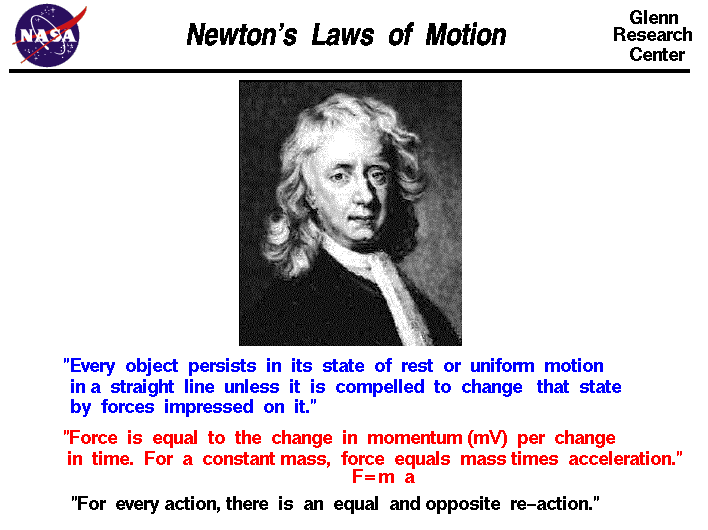
Newton's Laws Of Motion


Newton's First Law

Newton's First Law states that an object will remain at rest or in uniform motion in a straight line unless acted upon by an external force. It may be seen as a statement about inertia, that objects will remain in their state of motion unless a force acts to change the motion. Any change in motion involves an acceleration, and then Newton's Second Law applies; in fact, the First Law is just a special case of the Second Law for which the net external force is zero.
Newton's First Law contains implications about the fundamental symmetry of the universe in that a state of motion in a straight line must be just as "natural" as being at rest. If an object is at rest in one frame of reference, it will appear to be moving in a straight line to an observer in a reference frame which is moving by the object. There is no way to say which reference frame is "special", so all constant velocity reference frames must be equivalent.

Centripetal Force Example

The string must provide the necessary centripetal force to move the ball in a circle. If the string breaks, the ball will move off in a straight line. The straight line motion in the absence of the constraining force is an example of Newton's first law. The example here presumes that no other net forces are acting, such as horizontal motion on a frictionless surface. The vertical circle is more involved.


Newton's Second Law

Newton's Second Law as stated below applies to a wide range of physical phenomena, but it is not a fundamental principle like the Conservation Laws. It is applicable only if the force is the net external force. It does not apply directly to situations where the mass is changing, either from loss or gain of material, or because the object is traveling close to the speed of light where relativistic effects must be included. It does not apply directly on the very small scale of the atom where quantum mechanics must be used.
Data can be entered into any of the boxes below. Specifying any two of the quantities determines the third. After you have entered values for two, click on the text representing to third to calculate its value.

Newtons = kg * m/s2
pounds = slugs * ft/s2 


Newton's Second Law Illustration

Newton's 2nd Law enables us to compare the results of the same force exerted on objects of different mass.


Newton's Third Law

Newton's third law: All forces in the universe occur in equal but oppositely directed pairs. There are no isolated forces; for every external force that acts on an object there is a force of equal magnitude but opposite direction which acts back on the object which exerted that external force. In the case of internal forces, a force on one part of a system will be countered by a reaction force on another part of the system so that an isolated system cannot by any means exert a net force on the system as a whole. A system cannot "bootstrap" itself into motion with purely internal forces - to achieve a net force and an acceleration, it must interact with an object external to itself.
Without specifying the nature or origin of the forces on the two masses, Newton's 3rd law states that if they arise from the two masses themselves, they must be equal in magnitude but opposite in direction so that no net force arises from purely internal forces.
Newton's third law is one of the fundamental symmetry principles of the universe. Since we have no examples of it being violated in nature, it is a useful tool for analyzing situations which are somewhat counter-intuitive. For example, when a small truck collides head-on with a large truck, your intuition might tell you that the force on the small truck is larger. Not so!
Small truck,
large truck

Newton's Third Law Example

Newton's third law can be illustrated by identifying the pairs of forces which are involved in supporting the blocks on the spring scale.
Presuming that the blocks are supported and at equilibrium, then the net force on the system is zero. All the forces occur in Newton's third law pairs.


Watch video:

Tuesday, January 7, 2014

Blazar


blazar is a very compact quasar (quasi-stellar radio source) associated with a presumed super-massive black hole at the center of an active, giant elliptical galaxy. Blazars are among the most energetic phenomena in the universe and are an important topic inextragalactic astronomy.
Blazars are members of a larger group of active galaxies that host active galactic nuclei (AGN). A few rare objects may be "intermediate blazars" that appear to have a mixture of properties from both optically violent variable (OVV) quasars and BL Lac objects. The name "blazar" was originally coined in 1978 by astronomer Edward Spiegel to denote the combination of these two classes.
Blazars are AGN with a relativistic jet that is pointing in the general direction of the Earth. We observe "down" the jet, or nearly so, and this accounts for the rapid variability and compact features of both types of blazars. Many blazars have apparent superluminal features within the first few parsecs of their jets, probably due to relativistic shock fronts.
The generally accepted picture is that OVV quasars are intrinsically powerful radio galaxies while BL Lac objects are intrinsically weak radio galaxies. In both cases the host galaxies are giant ellipticals.
Alternative models, for example, gravitational lensing, may account for a few observations of some blazars which are not consistent with the general properties.

Structure
Galaxies AGN Jet Line-of-Sight.jpg
Blazars, like all AGN, are thought to be ultimately powered by material falling onto a super-massive black hole at the center of the host galaxy. Gas, dust and the occasional star are captured and spiral into this central black hole creating a hot accretion disk which generates enormous amounts of energy in the form of photons, electrons, positrons and other elementary particles. This region is quite small, approximately 10−3 parsecs in size.
There is also a larger opaque toroid extending several parsecs from the central black hole, containing a hot gas with embedded regions of higher density. These "clouds" can absorb and then re-emit energy from regions closer to the black hole. On Earth the clouds are detected as emission lines in the blazar spectrum.
Perpendicular to the accretion disk, a pair of relativistic jets carries a highly energetic plasma away from the AGN. The jet is collimated by a combination of intense magnetic fields and powerful winds from the accretion disk and toroid. Inside the jet, high energy photons and particles interact with each other and the strong magnetic field. These relativistic jets can extend as far as many tens of kiloparsecs from the central black hole.
All of these regions can produce a variety of observed energy, mostly in the form of a nonthermal spectrum ranging from very low frequency radio to extremely energetic gamma rays, with a high polarization (typically a few percent) at some frequencies. The nonthermal spectrum consists of synchrotron radiation in the radio to X-ray range, and inverse Compton emission in the X-ray to gamma-ray region. A thermal spectrum peaking in the ultraviolet region and faint optical emission lines are also present in OVV quasars, but faint or non-existent in BL Lac objects.

Relativistic beaming

Viewing angle - 1. at 90 degrees to the jet:: Radio galaxy / Seyfert 2 Galaxy; 2, 3. at an angle to the jet: Quasar/Seyfert 1 Galaxy; 4. down the jet: Blazar.
The observed emission from a blazar is greatly enhanced by relativistic effects in the jet, a process termed relativistic beaming. The bulk speed of the plasma that constitutes the jet can be in the range of 95%–99% of the speed of light. (This bulk velocity is not the speed of a typical electron or proton in the jet. The individual particles move in many directions with the result being that the net speed for the plasma is in the range mentioned.)
The relationship between the luminosity emitted in the rest frame of the jet and the luminosity observed from Earth depends on the characteristics of the jet. These include whether the luminosity arises from a shock front or a series of brighter blobs in the jet, as well as details of the magnetic fields within the jet and their interaction with the moving particles.
A simple model of beaming however, illustrates the basic relativistic effects connecting the luminosity emitted in the rest frame of the jet, Se and the luminosity observed on Earth, So. These are connected by a term referred to in astrophysics as the doppler factor, D, where So is proportional to Se × D2.
When looked at in much more detail than shown here, three relativistic effects are involved:
  • Relativistic Aberration contributes a factor of D2. Aberration is a consequence of special relativity where directions which appear isotropic in the rest frame (in this case, the jet) appear pushed towards the direction of motion in the observer's frame (in this case, the Earth).
  • Time Dilation contributes a factor of D+1. This effect speeds up the apparent release of energy. If the jet emits a burst of energy every minute in its own rest frame this may be observed on Earth as being a much faster release, perhaps one burst every ten seconds.
  • Windowing can contribute a factor of D−1 and then works to decrease the amount of boosting. This happens for a steady flow, because there are then D fewer elements of fluid within the observed window, as each element has been expanded by factor D. However, for a freely propagating blob of material, the radiation is boosted by the full D+3.

An example

Consider a jet with an angle to the lines of sight θ = 5° and a speed of 99.9% of the speed of light. On Earth the observed luminiosity is 70 times that of the emitted luminosity. However if θ is at the minimum value of 0° the jet will appear 600 times brighter from Earth.

Beaming away

Relativistic beaming also has another critical consequence. The jet which is not approaching Earth will appear dimmer because of the same relativistic effects. Therefore two intrinsically identical jets will appear significantly asymmetric. Indeed, in the example given above any jet where θ < 35° will be observed on Earth as less luminous than it would be from the rest frame of the jet.
A further consequence is that a population of intrinsically identical AGN scattered in space with random jet orientations will look like a very inhomogeneous population on Earth. The few objects where θ is small will have one very bright jet, while the rest will apparently have considerably weaker jets. Those where θ varies from 90° will appear to have asymmetric jets.
This is the essence behind the connection between blazars and radio galaxies. AGN which have jets oriented close to the line of sight with Earth can appear extremely different from other AGN even if they are intrinsically identical.

Discovery

Many of the brighter blazars were first identified, not as powerful distant galaxies, but as irregular variable stars in our own galaxy. These blazars, like genuine irregular variable stars, changed in brightness on periods of days or years, but with no pattern.
The early development of radio astronomy had shown that there are numerous bright radio sources in the sky. By the end of the 1950s the resolution of radio telescopes was sufficient to be able to identify specific radio sources with optical counterparts, leading to the discovery of quasars. Blazars were highly represented among these early quasars, and indeed the first redshift was found for 3C 273 — a highly variable quasar which is also a blazar.
In 1968 a similar connection between the "variable star" BL Lacertae and a powerful radio source VRO 42.22.01 was made. BL Lacertae shows many of the characteristics of quasars, but the optical spectrum was devoid of the spectral lines used to determine redshift. Faint indications of an underlying galaxy — proof that BL Lacertae was not a star — were found in 1974.
The extragalactic nature of BL Lacertae was not a surprise. In 1972 a few variable optical and radio sources were grouped together and proposed as a new class of galaxy: BL Lacertae-type objects. This terminology was soon shortened to "BL Lacertae object", "BL Lac object" or simply "BL Lac". (Note that the latter term can also mean the original blazar and not the entire class.)
As of 2003, a few hundred BL Lac objects are known.

Current vision

Blazars are thought to be active galactic nuclei, with relativistic jets oriented close to the line of sight with the observer.
The special jet orientation explains the general peculiar characteristics: high observed luminosity, very rapid variation, high polarization (when compared with non-blazar quasars), and the apparent superluminal motions detected along the first few parsecs of the jets in most blazars.
A Unified Scheme or Unified Model has become generally accepted where highly variable quasars are related to intrinsically powerful radio galaxies, and BL Lac objects are related to intrinsically weak radio galaxies. The distinction between these two connected populations explains the difference in emission line properties in blazars.
Alternate explanations for the relativistic jet/unified scheme approach which have been proposed include gravitational microlensing and coherent emission from the relativistic jet. Neither of these explain the overall properties of blazars. For example microlensing is achromatic. That is, all parts of a spectrum will rise and fall together. This is very clearly not observed in blazars. However it is possible that these processes, as well as more complex plasma physics can account for specific observations or some details.
Some examples of blazars include 3C 454.3, 3C 273, BL Lacertae, PKS 2155-304, Markarian 421, and Markarian 501. The latter two are also called "TeV Blazars" for their high energy (teraelectron-volt range) gamma-ray emission.


Watch video:


Quasars


It is a massive and extremely remote celestial object, emitting exceptionally large amounts of energy, which typically has a starlike image in a telescope. It has been suggested that quasars contain massive black holes and may represent a stage in the evolution of some galaxies.

Shining so brightly that they eclipse the ancient galaxies that contain them, quasars are distant objects powered by black holes a billion times as massive as our sun. These powerful dynamos have fascinated astronomers since their discovery half a century ago.
In the 1930s, Karl Jansky, a physicist with Bell Telephone Laboratories, discovered that the static interference on transatlantic phone lines was coming from the Milky Way. By the 1950s, astronomers were using radio telescopes to probe the heavens, and pairing their signals with visible examinations of the heavens.
Quasar Black Hole Water Vapor
However, some of the smaller point-source objects didn't have a match. Astronomers called them "quasi-stellar radio sources," or "quasars," because the signals came from one place, like a star.  Naming them didn't help determine what these objects were. It took years of study to realize that these distant specks, which seemed to indicate stars, are created by particles accelerated at velocities approaching the speed of light.


Shining so brightly that they eclipse the ancient galaxies that contain them, quasars are distant objects powered by black holes a billion times as massive as our sun. These powerful dynamos have fascinated astronomers since their discovery half a century ago.
In the 1930s, Karl Jansky, a physicist with Bell Telephone Laboratories, discovered that the static interference on transatlantic phone lines was coming from the Milky Way. By the 1950s, astronomers were using radio telescopes to probe the heavens, and pairing their signals with visible examinations of the heavens.

Light-speed jets
Scientists now suspect that the tiny, point-like glimmers are actually signals from galactic nuclei outshining their host galaxies. Quasars live only in galaxies with super-massive black holes — black holes that contain billions of times the mass of the sun. Although light cannot escape from the black hole itself, some signals can break free around its edges. While some dust and gas fall into the black hole, other particles are accelerated away from it at near the speed of light. The particles stream away from the black hole in jets above and below it, transported by one of the most powerful particle accelerators in the universe.
Most quasars have been found billions of light-years away. Because it takes light time to travel, studying objects in space functions much like a time machine; we see the object as it was when light left it, billions of years ago. Thus, the farther away scientists look, the farther back in time they can see. Most of the more than 2,000 known quasars existed in the early life of the galaxy. Galaxies like the Milky Way may once have hosted a quasar that has long been silent.
Quasars emit energies of millions, billions, or even trillions of electron volts. This energy exceeds the total of the light of all the stars within a galaxy. The brightest objects in the universe, they shine anywhere from 10 to 100,000 times brighter than the Milky Way.

Family tree
Quasars are part of a class of objects known as active galactic nuclei (AGN). Other classes include Seyfert galaxies and blazars. All three require supermassive black holes to power them.
Seyfert galaxies are the lowest energy AGN, putting out only about 100 kiloelectronvolts (KeV). Blazars, like their quasar cousins, put out significantly more energy.
Many scientists think that the three types of AGNs are the same objects, but with different perspectives. While the jets of quasars seem to stream at an angle generally in the direction of Earth, blazars may point their jets directly toward the planet. Although no jets are seen in Seyfert galaxies, scientists think this may be because we view them from the side, so all of the emission is pointed away from us and thus goes undetected.


Watch Video:
1.


2.

Many Universes Hypothesis


In 1954, a young Princeton University doctoral candidate named Hugh Everett III came up with a radical idea: That there exist parallel universes, exactly like our ­universe. These universes are all related to ours; indeed, they branch off from ours, and our universe is branched off of others. Within these parallel universes, our wars have had different outcomes than the ones we know. Species that are extinct in our universe have evolved and adapted in others. In other universes, we humans may have become extinct.
This thought boggles the mind and yet, it is still comprehensible. Notions of parallel universes or dimensions that resemble our own have appeared in works of science fiction and have been used as explanations for metaphysics. But why would a young up-and-coming physicist possibly risk his future career by posing a theory about parallel universes?
With his Many-Worlds theory, Everett was attempting to answer a rather sticky question related to quantum physics: Why does quantum matter behave erratically? The quantum level is the smallest one science has detected so far. The study of quantum physics began in 1900, when the physicist Max Planck first introduced the concept to the scientific world. Planck's study of radiation yielded some unusual findings that contradicted classical physical laws. These findings suggested that there are other laws at work in the universe, operating on a deeper level than the one we know
.

Heisenberg Uncertainty Principle

In fairly short order, physicists studying the quantum level noticed some peculiar things about this tiny world. For one, the particles that exist on this level have a way of taking different forms arbitrarily. For example, scientists have observed photons -- tiny packets of light -- acting as particles and waves. Even a single photon exhibits this shape-shifting [source: Brown University]. Imagine if you looked and acted like a solid human being when a friend glanced at you, but when he looked back again, you'd taken a gaseous form.
This has come to be known as the Heisenberg Uncertainty Principle. The physicist Werner Heisenberg suggested that just by observing quantum matter, we affect the behavior of that matter. Thus, we can never be fully certain of the nature of a quantum object or its attributes, like velocity and location.
This idea is supported by the Copenhagen interpretation of quantum mechanics. Posed by the Danish physicist Niels Bohr, this interpretation says that all quantum particles don't exist in one state or the other, but in all of its possible states at once. The sum total of possible states of a quantum object is called its wave function. The state of an object existing in all of its possible states at once is called its superposition.
According to Bohr, when we observe a quantum object, we affect its behavior. Observation breaks an object's superposition and essentially forces the object to choose one state from its wave function. This theory accounts for why physicists have taken opposite measurements from the same quantum object: The object "chose" different states during different measurements.
Bohr's interpretation was widely accepted, and still is by much of the quantum community. But lately, Everett's Many-Worlds theory has been getting some serious attention. Read the next page to find out how the Many-Worlds interpretation works.

Many Worlds Theory

Young Hugh Everett agreed with much of what the highly respected physicist Niels Bohr had suggested about the quantum world. He agreed with the idea of superposition, as well as with the notion of wave functions. But Everett disagreed with Bohr in one vital respect.
To Everett, measuring a quantum object does not force it into one comprehensible state or another. Instead, a measurement taken of a quantum object causes an actual split in the universe. The universe is literally duplicated, splitting into one universe for each possible outcome from the measurement. For example, say an object's wave function is both a particle and a wave. When a physicist measures the particle, there are two possible outcomes: It will either be measured as a particle or a wave. This distinction makes Everett's Many-Worlds theory a competitor of the Copenhagen interpretation as an explanation for quantum mechanics.
When a physicist measures the object, the universe splits into two distinct universes to accommodate each of the possible outcomes. So a scientist in one universe finds that the object has been measured in wave form. The same scientist in the other universe measures the object as a particle. This also explains how one particle can be measured in more than one state.
As unsettling as it may sound, Everett's Many-Worlds interpretation has implications beyond the quantum level. If an action has more than one possible outcome, then -- if Everett's theory is correct -- the universe splits when that action is taken. This holds true even when a person chooses not to take an action.
This means that if you have ever found yourself in a situation where death was a possible outcome, then in a universe parallel to ours, you are dead. This is just one reason that some find the Many-Worlds interpretation disturbing.
Another disturbing aspect of the Many-Worlds interpretation is that it undermines our concept of time as linear. Imagine a time line showing the history of the Vietnam War. Rather than a straight line showing noteworthy events progressing onward, a time line based on the Many-Worlds interpretation would show each possible outcome of each action taken. From there, each possible outcome of the actions taken (as a result of the original outcome) would be further chronicled.
But a person cannot be aware of his other selves -- or even his death -- that exist in parallel universes. So how could we ever know if the Many-Worlds theory is correct? Assurance that the interpretation is theoretically possible came in the late 1990s from a thought experiment -- an imagined experiment used to theoretically prove or disprove an idea -- called quantum suicide. (You can learn more about it in How Quantum Suicide Works.)
This thought experiment renewed interest in Everett's theory, which was for many years considered rubbish. Since Many-Worlds was proven possible, physicists and mathematicians have aimed to investigate the implications of the theory in depth. But the Many-Worlds interpretation is not the only theory that seeks to explain the universe. Nor is it the only one that suggests there are universes parallel to our own. Read the next page to lean about string theory.

Parallel Universes: Split or String?

The Many-Worlds theory and the Copenhagen interpretation aren't the only competitors ­trying to explain the basic level of the universe. In fact, quantum mechanics isn't even the only field within physics searching for such an explanation. The theories that have emerged from the study of subatomic physics still remain theories. This has caused the field of study to be divided in much the same way as the world of psychology. Theories have adherents and critics, as do the psychological frameworks proposed by Carl Jung, Albert Ellis and Sigmund Freud.
Since their science was developed, physicists have been engaged inreverse engineering the universe -- they have studied what they could observe and worked backward toward smaller and smaller levels of the physical world. By doing this, physicists are attempting to reach the final and most basic level. It is this level, they hope, that will serve as the foundation for understanding everything else.
Following his famous Theory of Relativity, Albert Einstein spent the rest of his life looking for the one final level that would answer all physical questions. Physicists refer to this phantom theory as the Theory of Everything. Quantum physicists believe that they are on the trail of finding that final theory. But another field of physics believes that the quantum level is not the smallest level, so it therefore could not provide the Theory of Everything.
These physicists turn instead to a theoretical sub-quantum level called string theory for the answers to all of life. What's amazing is that through their theoretical investigation, these physicists, like Everett, have also concluded that there are parallel universes.
String theory was originated by the Japanese-American physicist Michio Kaku. His theory says that the essential building blocks of all matter as well as all of the physical forces in the universe -- like gravity -- exist on a sub-quantum level. These building blocks resemble tiny rubber bands -- or strings -- that make up quarks (quantum particles), and in turn electrons, and atoms, and cells and so on. Exactly what kind of matter is created by the strings and how that matter behaves depends on the vibration of these strings. It is in this manner that our entire universe is composed. And according to string theory, this composition takes place across 11 separate dimensions.
Like the Many-Worlds theory, string theory demonstrates that parallel universes exist. According to the theory, our own universe is like a bubble that exists alongside similar parallel universes. Unlike the Many-Worlds theory, string theory supposes that these universes can come into contact with one another. String theory says that gravity can flow between these parallel universes. When these universes interact, a Big Bang like the one that created our universe occurs.
While physicists have managed to create machines that can detect quantum matter, the sub-quantum strings are yet to be observed, which makes them -- and the theory on which they're built -- entirely theoretical. It has been discredited by some, although others believe it is correct.
So do parallel universes really exist? According to the Many-Worlds theory, we can't truly be certain, since we cannot be aware of them. The string theory has already been tested at least once -- with negative results. Dr. Kaku still believes parallel dimensions do exist, however [source: The Guardian].
Einstein didn't live long enough to see his quest for the Theory of Everything taken up by others. Then again, if Many-Worlds is correct, Einstein's still alive in a parallel universe. Perhaps in that universe, physicists have already found the Theory of Everything.


Watch Videos:
1.


                                     2.

Wednesday, January 1, 2014

The Big Crunch Theory


We're all worried about what will happen at the end of our lives. We see other living things die, and we know it will happen to us. Because it's inevitable, we worry about when, where and how it will happen. Many of us also wonder about the fate of Earth. Will it be a hospitable blue ball forever, or will it eventually be consumed by the sun as it swells from a medium-sized yellow star to a red giant? Or perhaps we'll poison our planet, and it will float, cold and desolate, through space. If such a thing were to happen, how long would it take? A hundred years? A thousand? A million?
Some astronomers -- those who call themselves cosmologists -- ask similar questions about the universe. The scale that these scientists work at, of course, is much different. The universe is huge compared to a single planet, even a single galaxy, and its timeline is much, much longer. Because of this, cosmologists can't know with certainty how the universe began or how it will end. They can, however, collect evidence, make educated guesses and establish theories.
One such theory, concerning the future of the universe, is playfully known as the "big crunch." According to this theory, the universe will one day stop expanding. Then, as gravity pulls on the matter, the universe will begin to contract, falling inward until it has collapsed back into a super-hot, super-dense singularity. If the theory holds true, the universe is like a giant soufflé. It starts out small, then expands as it heats up. Eventually, however, the soufflé cools and begins to collapse.
Nobody likes a fallen soufflé, and we shouldn't like a universe that behaves like one. It spells the doom of every galaxy, star and planet that currently exists. Luckily, the big crunch is not a guarantee. Cosmologists are currently engaged in a hot debate. One camp says the soufflé will fall; the other camp says the soufflé will expand forever. It will be billions of years before we know for sure which camp is right.

The Big Crunch is one of the scenarios predicted by scientists in which the Universe may end. Just like many others, it is based on Einstein’s Theory of General Relativity. That is, if the Big Bang describes how the Universe most possibly began, the Big Crunch describes how it will end as a consequence of that beginning.
It tells us that the Universe’s expansion, which is due to the Big Bang, will not continue forever. Instead, at a certain point in time, it will stop expanding and collapse into itself, pulling everything with it until it eventually turns into the biggest black hole ever. Well, we all know how everything is squeezed when in that hole. Hence the name Big Crunch.
For scientists to predict with certainty the possibility of a Big Crunch, they will have to determine certain properties of the Universe. One of them is its density. It is believed that if the density is larger than a certain value, known as the critical density, an eventual collapse is highly possible.
You see, initially, scientists believed that there were only two factors that greatly influenced this expansion: the gravitational force of attraction between all the galaxies (which is proportional to the density) and their outward momentum due to the Big Bang.
Now, just like any body that goes against gravity, e.g. when you throw something up, that body will eventually give in and come back down for as long as there is no other force pushing it up.
Thus, that the gravitational forces will win in the end, once seemed like a logical prediction. But that was until scientists discovered that the Universe was actually increasing its rate of expansion at regions farthest from us.
To explain this phenomena, scientists had to assume the presence of an unknown entity, which they dubbed ‘dark energy’. It is widely believed that this entity is pushing all galaxies farther apart. With dark energy, and what little is known about it, in the picture, there seems to be little room for the possibility of a Big Crunch.
Right now, measurements made by NASA’s Chandra X-ray observatory indicate that the strength of dark energy in the University is constant. Just for added information, an increasing dark energy strength would have supported the possibility of a Big Rip, another universe ending that predicted everything (including atoms) to be ripped apart.
The big bounce take on the life cycle of the universe

Death and Rebirth

Clearly, there's no easy answer when it comes to predicting the fate of the universe. But let's imagine for a ­moment th­at the density of the universe is above the critical value required to stop expansion. This would lead to the big crunch, which in many ways would be like hitting the rewind button on a VCR. As gravity within the universe pulled everything back, galaxy clusters would draw closer together. Then individual galaxies would begin to merge until, after billions of years, one mega-galaxy would form.
Inside this gigantic cauldron, stars would meld together, causing all of space to become hotter than the sun. Eventually, stars would explode and black holes would emerge, slowly at first and then more rapidly. As the end drew near, the black holes would suck up everything around them. Even they would coalesce at some point to form a monstrous black hole that would pull the universe closed like a drawstring bag. At the end, nothing would remain but a super-hot, super-dense singularity -- the seed of another universe. Many astronomers think the seed would germinate in a "big bounce," starting the whole process over again.
That's not the only theory. A few cosmologists, led by Paul J. Steinhardt of Princeton University and Neil Turok of Cambridge University, have recently argued that the big chill and the big crunch are not mutually exclusive. Their model works like this: The universe began with the big bang, which was followed by a period of slow expansion and gradual accumulation of dark energy. This is where we are today. What happens next is highly speculative, but Steinhardt and Turok believe that the dark energy will continue to accumulate and, as it does, will stimulate cosmic acceleration. The universe won't ever stop expanding, but will spread out over trillions of years, stretching all matter and energy to such an extreme that our one universe will be separated into multiple universes. Inside these universes, the mysterious dark energy will materialize into normal matter and radiation. This will trigger another big bang -- perhaps several of them -- and another cycle of expansion.
If you're disconcerted by all this talk of crunching and expanding, you can take comfort in knowing that the fate of the universe won't be determined for billions, maybe even trillions, of years. That gives you plenty of time to focus on things that are a bit more certain, such as your own life cycle of birth, growth and death.

Watch video:
Tachyon

File:Tachyon04s.gif

tachyon or tachyonic particle is a hypothetical particle that always moves faster than light. The word comes from the Greek: ταχύς or tachys, meaning "swift, quick, fast, rapid", and was coined by Gerald Feinberg. Most physicists think that faster-than-light particles cannot exist because they are not consistent with the known laws of physics. If such particles did exist, they could be used to build a tachyonic anti-telephone and send signals faster than light, which (according to special relativity) would lead to violations of causality. Potentially consistent theories that allow faster-than-light particles include those that break Lorentz invariance, the symmetry underlying special relativity, so that the speed of light is not a barrier.
In the 1967 paper that coined the term, Feinberg proposed that tachyonic particles could be quanta of a quantum field with negative squared mass. However, it was soon realized that excitations of such imaginary mass fields do not in fact propagate faster than light, and instead represent an instability known as tachyon condensation.Nevertheless, negative squared mass fields are commonly referred to as "tachyons", and in fact have come to play an important role in modern physics.
Despite theoretical arguments against the existence of faster-than-light particles, experiments have been conducted to search for them. No compelling evidence for their existence has been found.

Tachyons in relativistic theory
In special relativity, a faster-than-light particle would have space-like four-momentum, in contrast to ordinary particles that have time-like four-momentum. It would also have imaginary mass. Being constrained to the spacelike portion of the energy–momentum graph, it could not slow down to subluminal speeds.

Mass

In a Lorentz invariant theory, the same formulas that apply to ordinary slower-than-light particles (sometimes called "bradyons" in discussions of tachyons) must also apply to tachyons. In particular the energy–momentum relation:
E^2 = p^2c^2 + m^2c^4 \;
(where p is the relativistic momentum of the bradyon and m is its rest mass) should still apply, along with the formula for the total energy of a particle:
E = \frac{mc^2}{\sqrt{1 - \frac{v^2}{c^2}}}.
This equation shows that the total energy of a particle (bradyon or tachyon) contains a contribution from its rest mass (the "rest mass–energy") and a contribution from its motion, the kinetic energy. When v is larger than c, the denominator in the equation for the energy is "imaginary", as the value under the radical is negative. Because the total energy must be real, the numerator must also be imaginary: i.e. the rest mass m must be imaginary, as a pure imaginary number divided by another pure imaginary number is a real number.

Speed

One curious effect is that, unlike ordinary particles, the speed of a tachyon increases as its energy decreases. In particular,  E approaches zero when  v  approaches infinity. (For ordinary bradyonic matter, E increases with increasing speed, becoming arbitrarily large as v approaches c, the speed of light). Therefore, just as bradyons are forbidden to break the light-speed barrier, so too are tachyons forbidden from slowing down to below c, because infinite energy is required to reach the barrier from either above or below.
As noted by Einstein, Tolman, and others, special relativity implies that faster-than-light particles, if they existed, could be used to communicate backwards in time.

Neutrinos

In 1985 Chodos et al. proposed that neutrinos can have a tachyonic nature. The possibility of standard model particles moving at superluminal speeds can be modeled using Lorentz invariance violating terms, for example in the Standard-Model Extension. In this framework, neutrinos experience Lorentz-violating oscillations and can travel faster than light at high energies. This proposal was strongly criticized.

Cherenkov radiation

A tachyon with an electric charge would lose energy as Cherenkov radiation—just as ordinary charged particles do when they exceed the local speed of light in a medium. A charged tachyon traveling in a vacuum therefore undergoes a constant proper time acceleration and, by necessity, its worldline forms a hyperbola in space-time. However reducing a tachyon's energy increases its speed, so that the single hyperbola formed is of two oppositely charged tachyons with opposite momenta (same magnitude, opposite sign) which annihilate each other when they simultaneously reach infinite speed at the same place in space. (At infinite speed the two tachyons have no energy each and finite momentum of opposite direction, so no conservation laws are violated in their mutual annihilation. The time of annihilation is frame dependent.)
Even an electrically neutral tachyon would be expected to lose energy via gravitational Cherenkov radiation, because it has a gravitational mass, and therefore increase in speed as it travels, as described above. If the tachyon interacts with any other particles, it can also radiate Cherenkov energy into those particles. Neutrinos interact with the other particles of the Standard Model, and Andrew Cohen and Sheldon Glashow recently used this to argue that the faster-than-light neutrino anomaly cannot be explained by making neutrinos propagate faster than light, and must instead be due to an error in the experiment.

Causality

Causality is a fundamental principle of physics. If tachyons can transmit information faster than light, then according to relativity they violate causality, leading to logical paradoxes of the "kill your own grandfather" type. This is often illustrated with thought experiments such as the "tachyon telephone paradox" or "logically pernicious self-inhibitor."
The problem can be understood in terms of the relativity of simultaneity in special relativity, which says that different inertial reference frames will disagree on whether two events at different locations happened "at the same time" or not, and they can also disagree on the order of the two events (technically, these disagreements occur when spacetime interval between the events is 'space-like', meaning that neither event lies in the future light cone of the other).
If one of the two events represents the sending of a signal from one location and the second event represents the reception of the same signal at another location, then as long as the signal is moving at the speed of light or slower, the mathematics of simultaneity ensures that all reference frames agree that the transmission-event happened before the reception-event. However, in the case of a hypothetical signal moving faster than light, there would always be some frames in which the signal was received before it was sent, so that the signal could be said to have moved backwards in time. Because one of the two fundamental postulates of special relativity says that the laws of physics should work the same way in every inertial frame, if it is possible for signals to move backwards in time in any one frame, it must be possible in all frames. This means that if observer A sends a signal to observer B which moves faster than light in A's frame but backwards in time in B's frame, and then B sends a reply which moves faster than light in B's frame but backwards in time in A's frame, it could work out that A receives the reply before sending the original signal, challenging causality in every frame and opening the door to severe logical paradoxes. Mathematical details can be found in the tachyonic antitelephone article, and an illustration of such a scenario using spacetime diagrams can be found in Baker, R. (2003)

Reinterpretation principle

The reinterpretation principle asserts that a tachyon sent back in time can always be reinterpreted as a tachyon travelingforward in time, because observers cannot distinguish between the emission and absorption of tachyons. The attempt to detect a tachyon from the future (and violate causality) would actually create the same tachyon and send it forward in time (which is causal).
However, this principle is not widely accepted as resolving the paradoxes. Instead, what would be required to avoid paradoxes is that unlike any known particle, tachyons do not interact in any way and can never be detected or observed, because otherwise a tachyon beam could be modulated and used to create an anti-telephone or a "logically pernicious self-inhibitor". All forms of energy are believed to interact at least gravitationally, and many authors state that superluminal propagation in Lorentz invariant theories always leads to causal paradoxes.

Fundamental models
In modern physics, all fundamental particles are regarded as excitations of quantum fields. There are several distinct ways in which tachyonic particles could be embedded into a field theory.

Fields with imaginary mass

In the paper that coined the term "tachyon", Gerald Feinberg studied Lorentz invariant quantum fields with imaginary mass. Because the group velocity for such a field is superluminal, naively it appears that its excitations propagate faster than light. However, it was quickly understood that the superluminal group velocity does not correspond to the speed of propagation of any localized excitation (like a particle). Instead, the negative mass represents an instability to tachyon condensation, and all excitations of the field propagate subluminally and are consistent with causality.Despite having no faster-than-light propagation, such fields are referred to simply as "tachyons" in many sources.
Tachyonic fields play an important role in modern physics. Perhaps the most famous is the Higgs boson of the Standard Model of particle physics, which—in its uncondensed phase—has an imaginary mass. In general, the phenomenon of spontaneous symmetry breaking, which is closely related to tachyon condensation, plays a very important role in many aspects of theoretical physics, including the Ginzburg–Landau and BCS theories of superconductivity. Another example of a tachyonic field is the tachyon of bosonic string theory.

Lorentz violating theories

In theories that do not respect Lorentz invariance the speed of light is not (necessarily) a barrier, and particles can travel faster than the speed of light without infinite energy or causal paradoxes. A class of field theories of that type are the so-called Standard Model extensions. However, the experimental evidence for Lorentz invariance is extremely good, so such theories are very tightly constrained.

Fields with non-canonical kinetic term

By modifying the kinetic energy of the field, it is possible to produce Lorentz invariant field theories with excitations that propagate superluminally. However, such theories in general do not have a well-defined Cauchy problem (for reasons related to the issues of causality discussed above), and are probably inconsistent quantum mechanically.

History
As mentioned above, the term "tachyon" was coined by Gerald Feinberg in a 1967 paper titled "Possibility of Faster-Than-Light Particles". Feinberg studied the kinematics of such particles according to special relativity. In his paper he also introduced fields with imaginary mass (now also referred to as "tachyons") in an attempt to understand the microphysical origin such particles might have.
The first hypothesis regarding faster-than-light particles is sometimes attributed to German physicist Arnold Sommerfeld in 1904, and more recent discussions happened in 1962 and 1969.


Watch video: