~Fun With Physics~ ©

If physics is innovates you, then this certainly has to be innovative too......................................... Download official android app - http://www.appsgeyser.com/707739

Wednesday, January 1, 2014

Tachyon

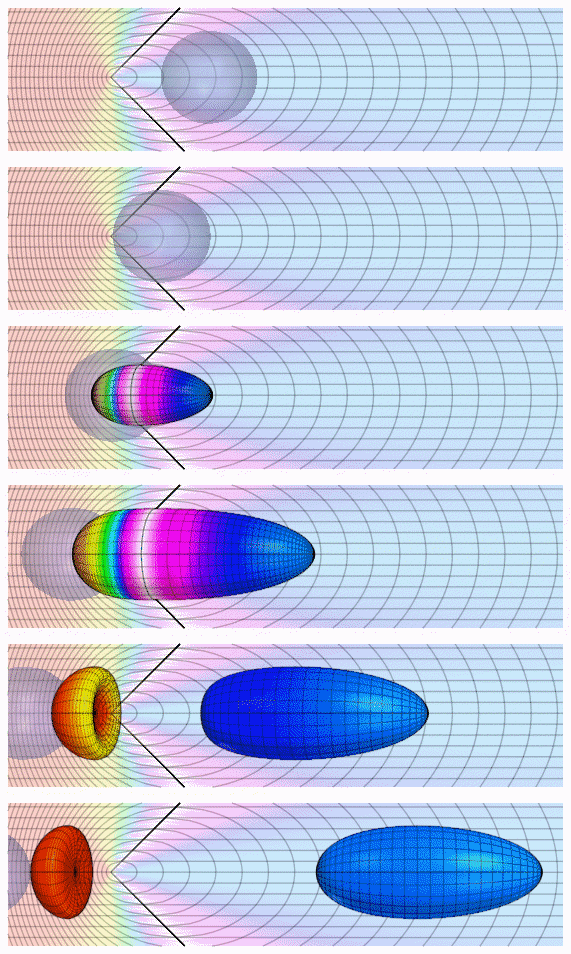
File:Tachyon04s.gif

A tachyon or tachyonic particle is a hypothetical particle that always moves faster than light. The word comes from the Greek: ταχύς or tachys, meaning "swift, quick, fast, rapid", and was coined by Gerald Feinberg. Most physicists think that faster-than-light particles cannot exist because they are not consistent with the known laws of physics. If such particles did exist, they could be used to build a tachyonic anti-telephone and send signals faster than light, which (according to special relativity) would lead to violations of causality. Potentially consistent theories that allow faster-than-light particles include those that break Lorentz invariance, the symmetry underlying special relativity, so that the speed of light is not a barrier.
In the 1967 paper that coined the term, Feinberg proposed that tachyonic particles could be quanta of a quantum field with negative squared mass. However, it was soon realized that excitations of such imaginary mass fields do not in fact propagate faster than light, and instead represent an instability known as tachyon condensation.Nevertheless, negative squared mass fields are commonly referred to as "tachyons", and in fact have come to play an important role in modern physics.
Despite theoretical arguments against the existence of faster-than-light particles, experiments have been conducted to search for them. No compelling evidence for their existence has been found.

Tachyons in relativistic theory
In special relativity, a faster-than-light particle would have space-like four-momentum, in contrast to ordinary particles that have time-like four-momentum. It would also have imaginary mass. Being constrained to the spacelike portion of the energy–momentum graph, it could not slow down to subluminal speeds.

Mass

In a Lorentz invariant theory, the same formulas that apply to ordinary slower-than-light particles (sometimes called "bradyons" in discussions of tachyons) must also apply to tachyons. In particular the energy–momentum relation:

E^2 = p^2c^2 + m^2c^4 \;
(where p is the relativistic momentum of the bradyon and m is its rest mass) should still apply, along with the formula for the total energy of a particle:
E = \frac{mc^2}{\sqrt{1 - \frac{v^2}{c^2}}}.
This equation shows that the total energy of a particle (bradyon or tachyon) contains a contribution from its rest mass (the "rest mass–energy") and a contribution from its motion, the kinetic energy. When v is larger than c, the denominator in the equation for the energy is "imaginary", as the value under the radical is negative. Because the total energy must be real, the numerator must also be imaginary: i.e. the rest mass m must be imaginary, as a pure imaginary number divided by another pure imaginary number is a real number.

Speed

One curious effect is that, unlike ordinary particles, the speed of a tachyon increases as its energy decreases. In particular,  E approaches zero when  v  approaches infinity. (For ordinary bradyonic matter, E increases with increasing speed, becoming arbitrarily large as v approaches c, the speed of light). Therefore, just as bradyons are forbidden to break the light-speed barrier, so too are tachyons forbidden from slowing down to below c, because infinite energy is required to reach the barrier from either above or below.
As noted by Einstein, Tolman, and others, special relativity implies that faster-than-light particles, if they existed, could be used to communicate backwards in time.

Neutrinos

In 1985 Chodos et al. proposed that neutrinos can have a tachyonic nature. The possibility of standard model particles moving at superluminal speeds can be modeled using Lorentz invariance violating terms, for example in the Standard-Model Extension. In this framework, neutrinos experience Lorentz-violating oscillations and can travel faster than light at high energies. This proposal was strongly criticized.

Cherenkov radiation

A tachyon with an electric charge would lose energy as Cherenkov radiation—just as ordinary charged particles do when they exceed the local speed of light in a medium. A charged tachyon traveling in a vacuum therefore undergoes a constant proper time acceleration and, by necessity, its worldline forms a hyperbola in space-time. However reducing a tachyon's energy increases its speed, so that the single hyperbola formed is of two oppositely charged tachyons with opposite momenta (same magnitude, opposite sign) which annihilate each other when they simultaneously reach infinite speed at the same place in space. (At infinite speed the two tachyons have no energy each and finite momentum of opposite direction, so no conservation laws are violated in their mutual annihilation. The time of annihilation is frame dependent.)
Even an electrically neutral tachyon would be expected to lose energy via gravitational Cherenkov radiation, because it has a gravitational mass, and therefore increase in speed as it travels, as described above. If the tachyon interacts with any other particles, it can also radiate Cherenkov energy into those particles. Neutrinos interact with the other particles of the Standard Model, and Andrew Cohen and Sheldon Glashow recently used this to argue that the faster-than-light neutrino anomaly cannot be explained by making neutrinos propagate faster than light, and must instead be due to an error in the experiment.

Causality

Causality is a fundamental principle of physics. If tachyons can transmit information faster than light, then according to relativity they violate causality, leading to logical paradoxes of the "kill your own grandfather" type. This is often illustrated with thought experiments such as the "tachyon telephone paradox" or "logically pernicious self-inhibitor."
The problem can be understood in terms of the relativity of simultaneity in special relativity, which says that different inertial reference frames will disagree on whether two events at different locations happened "at the same time" or not, and they can also disagree on the order of the two events (technically, these disagreements occur when spacetime interval between the events is 'space-like', meaning that neither event lies in the future light cone of the other).
If one of the two events represents the sending of a signal from one location and the second event represents the reception of the same signal at another location, then as long as the signal is moving at the speed of light or slower, the mathematics of simultaneity ensures that all reference frames agree that the transmission-event happened before the reception-event. However, in the case of a hypothetical signal moving faster than light, there would always be some frames in which the signal was received before it was sent, so that the signal could be said to have moved backwards in time. Because one of the two fundamental postulates of special relativity says that the laws of physics should work the same way in every inertial frame, if it is possible for signals to move backwards in time in any one frame, it must be possible in all frames. This means that if observer A sends a signal to observer B which moves faster than light in A's frame but backwards in time in B's frame, and then B sends a reply which moves faster than light in B's frame but backwards in time in A's frame, it could work out that A receives the reply before sending the original signal, challenging causality in every frame and opening the door to severe logical paradoxes. Mathematical details can be found in the tachyonic antitelephone article, and an illustration of such a scenario using spacetime diagrams can be found in Baker, R. (2003)

Reinterpretation principle

The reinterpretation principle asserts that a tachyon sent back in time can always be reinterpreted as a tachyon travelingforward in time, because observers cannot distinguish between the emission and absorption of tachyons. The attempt to detect a tachyon from the future (and violate causality) would actually create the same tachyon and send it forward in time (which is causal).
However, this principle is not widely accepted as resolving the paradoxes. Instead, what would be required to avoid paradoxes is that unlike any known particle, tachyons do not interact in any way and can never be detected or observed, because otherwise a tachyon beam could be modulated and used to create an anti-telephone or a "logically pernicious self-inhibitor". All forms of energy are believed to interact at least gravitationally, and many authors state that superluminal propagation in Lorentz invariant theories always leads to causal paradoxes.

Fundamental models
In modern physics, all fundamental particles are regarded as excitations of quantum fields. There are several distinct ways in which tachyonic particles could be embedded into a field theory.

Fields with imaginary mass


In the paper that coined the term "tachyon", Gerald Feinberg studied Lorentz invariant quantum fields with imaginary mass. Because the group velocity for such a field is superluminal, naively it appears that its excitations propagate faster than light. However, it was quickly understood that the superluminal group velocity does not correspond to the speed of propagation of any localized excitation (like a particle). Instead, the negative mass represents an instability to tachyon condensation, and all excitations of the field propagate subluminally and are consistent with causality.Despite having no faster-than-light propagation, such fields are referred to simply as "tachyons" in many sources.
Tachyonic fields play an important role in modern physics. Perhaps the most famous is the Higgs boson of the Standard Model of particle physics, which—in its uncondensed phase—has an imaginary mass. In general, the phenomenon of spontaneous symmetry breaking, which is closely related to tachyon condensation, plays a very important role in many aspects of theoretical physics, including the Ginzburg–Landau and BCS theories of superconductivity. Another example of a tachyonic field is the tachyon of bosonic string theory.

Lorentz violating theories

In theories that do not respect Lorentz invariance the speed of light is not (necessarily) a barrier, and particles can travel faster than the speed of light without infinite energy or causal paradoxes. A class of field theories of that type are the so-called Standard Model extensions. However, the experimental evidence for Lorentz invariance is extremely good, so such theories are very tightly constrained.

Fields with non-canonical kinetic term

By modifying the kinetic energy of the field, it is possible to produce Lorentz invariant field theories with excitations that propagate superluminally. However, such theories in general do not have a well-defined Cauchy problem (for reasons related to the issues of causality discussed above), and are probably inconsistent quantum mechanically.

History
As mentioned above, the term "tachyon" was coined by Gerald Feinberg in a 1967 paper titled "Possibility of Faster-Than-Light Particles". Feinberg studied the kinematics of such particles according to special relativity. In his paper he also introduced fields with imaginary mass (now also referred to as "tachyons") in an attempt to understand the microphysical origin such particles might have.
The first hypothesis regarding faster-than-light particles is sometimes attributed to German physicist Arnold Sommerfeld in 1904, and more recent discussions happened in 1962 and 1969.


Watch video:

Posted by Unknown at 12:53 PM No comments:
Email ThisBlogThis!Share to XShare to FacebookShare to Pinterest

Monday, December 30, 2013

Diamond Rain


Diamonds big enough to be worn by Hollywood film stars could be raining down on Saturn and Jupiter, US scientists have calculated.

New atmospheric data for the gas giants indicates that carbon is abundant in its dazzling crystal form, they say.

Lightning storms turn methane into soot (carbon) which as it falls hardens into chunks of graphite and then diamond.

These diamond "hail stones" eventually melt into a liquid sea in the planets' hot cores, they told a conference.

Continue reading the main story
“
Start Quote

People ask me - how can you really tell? It all boils down to the chemistry. And we think we're pretty certain”

Dr Kevin Baines
University of Wisconsin-Madison
The biggest diamonds would likely be about a centimetre in diameter - "big enough to put on a ring, although of course they would be uncut," says Dr Kevin Baines, of the University of Wisconsin-Madison and Nasa's Jet Propulsion Laboratory.

He added they would be of a size that the late film actress Elizabeth Taylor would have been "proud to wear".

"The bottom line is that 1,000 tonnes of diamonds a year are being created on Saturn.

"People ask me - how can you really tell? Because there's no way you can go and observe it.

"It all boils down to the chemistry. And we think we're pretty certain."

Thunderstorm alleys
Baines presented his unpublished findings at the annual meeting of the Division for Planetary Sciences of the American Astronomical Society in Denver, Colorado, alongside his co-author Mona Delitsky, from California Speciality Engineering.

Saturn
Gigantic storms on Saturn create black clouds of soot - which hardens into diamonds as it falls
Uranus and Neptune have long been thought to harbour gemstones. But Saturn and Jupiter were not thought to have suitable atmospheres.

Baines and Delitsky analysed the latest temperature and pressure predictions for the planets' interiors, as well as new data on how carbon behaves in different conditions.

They concluded that stable crystals of diamond will "hail down over a huge region" of Saturn in particular.

"It all begins in the upper atmosphere, in the thunderstorm alleys, where lightning turns methane into soot," said Baines.

"As the soot falls, the pressure on it increases. And after about 1,000 miles it turns to graphite - the sheet-like form of carbon you find in pencils."

By a depth of 6,000km, these chunks of falling graphite toughen into diamonds - strong and unreactive.

These continue to fall for another 30,000km - "about two-and-a-half Earth-spans" says Baines.

"Once you get down to those extreme depths, the pressure and temperature is so hellish, there's no way the diamonds could remain solid.

"It's very uncertain what happens to carbon down there."

One possibility is that a "sea" of liquid carbon could form.

"Diamonds aren't forever on Saturn and Jupiter. But they are on Uranus and Neptune, which are colder at their cores," says Baines.

'Rough diamond'
The findings are yet to be peer reviewed, but other planetary experts contacted by BBC News said the possibility of diamond rain "cannot be dismissed".

"The idea that there is a depth range within the atmospheres of Jupiter and (even more so) Saturn within which carbon would be stable as diamond does seem sensible," says Prof Raymond Jeanloz, one of the team who first predicted diamonds on Uranus and Neptune.

"And given the large sizes of these planets, the amount of carbon (therefore diamond) that may be present is hardly negligible."

However Dr Nadine Nettelmann, of the University of California, Santa Cruz, said further work was needed to understand whether carbon can form diamonds in an atmosphere which is rich in hydrogen and helium - such as Saturn's.

55 Cancri e
The planet 55 Cancri e may not be so precious after all, a new study suggests
"Baines and Delitsky considered the data for pure carbon, instead of a carbon-hydrogen-helium mixture," she explained.

"We cannot exclude the proposed scenario (diamond rain on Saturn and Jupiter) but we simply have no data on mixtures in the planets. So we do not know if diamond formation occurs at all."

Meanwhile, an exoplanet that was believed to consist largely of diamond may not be so precious after all, according to new research.

The so-called "diamond planet" 55 Cancri e orbits a star 40 light-years from our Solar System.

A study in 2010 suggested it was a rocky world with a surface of graphite surrounding a thick layer of diamond, instead of water and granite like Earth.

But new research to be published in the Astrophysical Journal, calls this conclusion in question, making it unlikely any space probe sent to sample the planet's innards would dig up anything sparkling.

Carbon, the element diamonds are made of, now appears to be less abundant in relation to oxygen in the planet's host star - and by extension, perhaps the planet.

"Based on what we know at this point, 55 Cancri e is more of a 'diamond in the rough'," said author Johanna Teske, of the University of Arizona.


Watch videos:
1.


2.


Posted by Unknown at 11:17 PM No comments:
Email ThisBlogThis!Share to XShare to FacebookShare to Pinterest


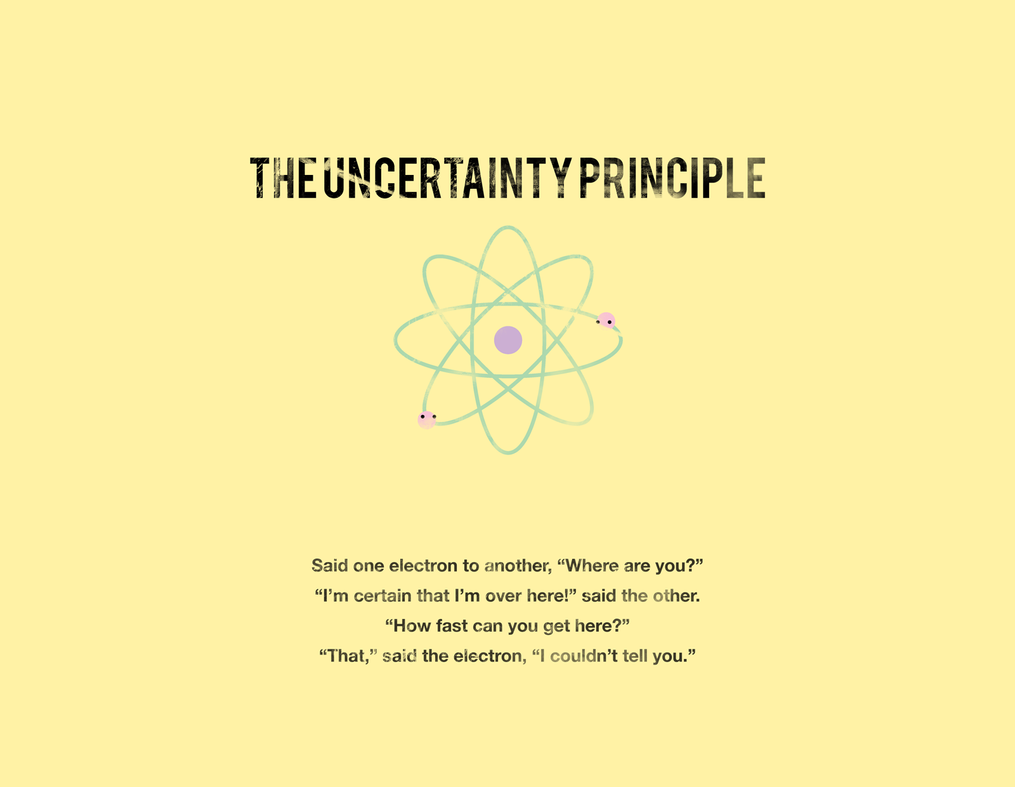
Uncertainty Principle


One of the biggest problems with quantum experiments is the seemingly unavoidable tendency of humans to influence the situation and velocity of small particles. This happens just by our observing the particles, and it has quantum physicists frustrated. To combat this, physicists have created enormous, elaborate machines like particle accelerators that remove any physical human influence from the process of accelerating a particle's energy of motion.
Still, the mixed results quantum physicists find when examining the same particle indicate that we just can't help but affect the behavior of quanta -- or quantum particles. Even the light physicists use to help them better see the objects they're observing can influence the behavior of quanta. Photons, for example -- the smallest measure of light, which have no mass or electrical charge -- can still bounce a particle around, changing its velocity and speed.
This is called Heisenberg's Uncertainty Principle. Werner Heisenberg, a German physicist, determined that our observations have an effect on the behavior of quanta. Heisenberg's Uncertainty Principle sounds difficult to understand -- even the name is kind of intimidating. But it's actually easy to comprehend, and once you do, you'll understand the fundamental principle of quantum mechanics.
Imagine that you're blind and over time you've developed a technique for determining how far away an object is by throwing a medicine ball at it. If you throw your medicine ball at a nearby stool, the ball will return quickly, and you'll know that it's close. If you throw the ball at something across the street from you, it'll take longer to return, and you'll know that the object is far away.
The problem i­s that when you throw a ball -- especially a heavy one like a medicine ball -- at something like a stool, the ball will knock the stool across the room and may even have enough momentum to bounce back. You can say where the stool was, but not where it is now. What's more, you could calculate the velocity of the stool after you hit it with the ball, but you have no idea what its velocity was before you hit it.
This is the problem revealed by Heisenberg's Uncertainty Principle. To know the velocity of a quark we must measure it, and to measure it, we are forced to affect it. The same goes for observing an object's position. Uncertainty about an object's position and velocity makes it difficult for a physicist to determine much about the object.
Of course, physicists aren't exactly throwing medicine balls at quanta to measure them, but even the slightest interference can cause the incredibly small particles to behave differently.
This is why quantum physicists are forced to create thought experiments based on the observations from the real experiments conducted at the quantum level. These thought experiments are meant to prove or disprove interpretations -- explanations for the whole of quantum theory.
In the next section, we'll look at the basis for quantum suicide -- the Many-Worlds interpretation of quantum mechanics.


Watch video:

Posted by Unknown at 10:09 PM No comments:
Email ThisBlogThis!Share to XShare to FacebookShare to Pinterest

Maxwell's Equations


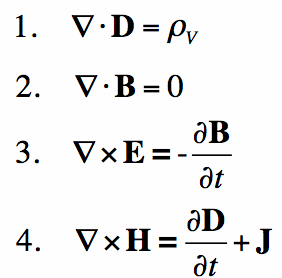
Maxwell's Equations are a set of 4 complicated equations that describe the world of electromagnetics. These equations describe how electric and magnetic fields propagate, interact, and how they are influenced by objects.
James Clerk Maxwell [1831-1879] was an Einstein/Newton-level genius who took a set of known experimental laws (Faraday's Law, Ampere's Law) and unified them into a symmetric coherent set of Equations known as Maxwell's Equations. Maxwell was one of the first to determine the speed of propagation of electromagnetic (EM) waves was the same as the speed of light - and hence to conclude that EM waves and visible light were really the same thing.
Maxwell's Equations are critical in understanding Antennas and Electromagnetics. They are formidable to look at - so complicated that most electrical engineers and physicists don't even really know what they mean. Shrouded in complex math (which is likely so "intellectual" people can feel superior in discussing them), true understanding of these equations is hard to come by.
This leads to the reason for this website - an intuitive tutorial of Maxwell's Equations. I will avoid if at all possible the mathematical difficulties that arise, and instead describe what the equations mean. And don't be afraid - the math is so complicated that those who do understand complex vector calculus still cannot apply Maxwell's Equations in anything but the simplest scenarios. For this reason, intuitive knowledge of Maxwell's Equations is far superior than mathematical manipulation-based knowledge. To understand the world, you must understand what equations mean, and not just know mathematical constructs. I believe the accepted methods of teaching electromagnetics and Maxwell's Equations do not produce understanding. And with that, let's say something about these equations.
Maxwell's Equations are laws - just like the law of gravity. These equations are rules the universe uses to govern the behavior of electric and magnetic fields. A flow of electric current will produce a magnetic field. If the current flow varies with time (as in any wave or periodic signal), the magnetic field will also give rise to an electric field. Maxwell's Equations shows that separated charge (positive and negative) gives rise to an electric field - and if this is varying in time as well will give rise to a propagating electric field, further giving rise to a propgating magnetic field.
To understand Maxwell's Equations at a more intuitive level than most Ph.Ds in Engineering or Physics, click through the links and definitions above. You'll find that the complicated math masks an inner elegance to these equations - and you'll learn how the universe operates the Electromagnetic Machine.

maxwell's equations


Watch video:


Posted by Unknown at 10:33 AM No comments:
Email ThisBlogThis!Share to XShare to FacebookShare to Pinterest

Sunday, December 29, 2013

Quantum Computing


The massive amount of processing power generated by computer manufacturers has not yet been able to quench our thirst for speed and computing capacity. In 1947, American computer engineer Howard Aiken said that just six electronic digital computers would satisfy the computing needs of the United States. Others have made similar errant predictions about the amount of computing power that would support our growing technological needs. Of course, Aiken didn't count on the large amounts of data generated by scientific research, the proliferation of personal computers or the emergence of the Internet, which have only fueled our need for more, more and more computing power.
Will we ever have the amount of computing power we need or want? If, as Moore's Law states, the number of transistors on a microprocessor continues to double every 18 months, the year 2020 or 2030 will find the circuits on a microprocessor measured on an atomic scale. And the logical next step will be to create quantum computers, which will harness the power of atoms and molecules to perform memory and processing tasks. Quantum computers have the potential to perform certain calculations significantly faster than any silicon-based computer.
Scientists have already built basic quantum computers that can perform certain calculations; but a practical quantum computer is still years away. In this article, you'll learn what a quantum computer is and just what it'll be used for in the next era of computing.
You don't have to go back too far to find the origins of quantum computing. While computers have been around for the majority of the 20th century, quantum computing was first theorized less than 30 years ago, by a physicist at the Argonne National Laboratory. Paul Benioff is credited with first applying quantum theory to computers in 1981. Benioff theorized about creating a quantum Turing machine. Most digital computers, like the one you are using to read this article, are based on the Turing Theory. Learn what this is in the next section.

Defining the Quantum Computer

The Turing machine, developed by Alan Turing in the 1930s, is a theoretical device that consists of tape of unlimited length that is divided into little squares. Each square can either hold a symbol (1 or 0) or be left blank. A read-write device reads these symbols and blanks, which gives the machine its instructions to perform a certain program. Does this sound familiar? Well, in a quantum Turing machine, the difference is that the tape exists in a quantum state, as does the read-write head. This means that the symbols on the tape can be either 0 or 1 or a superposition of 0 and 1; in other words the symbols are both 0 and 1 (and all points in between) at the same time. While a normal Turing machine can only perform one calculation at a time, a quantum Turing machine can perform many calculations at once.
Today's computers, like a Turing machine, work by manipulating bits that exist in one of two states: a 0 or a 1. Quantum computers aren't limited to two states; they encode information as quantum bits, or qubits, which can exist in superposition. Qubits represent atoms, ions, photons or electrons and their respective control devices that are working together to act as computer memory and a processor. Because a quantum computer can contain these multiple states simultaneously, it has the potential to be millions of times more powerful than today's most powerful supercomputers.
This superposition of qubits is what gives quantum computers their inherent parallelism. According to physicist David Deutsch, this parallelism allows a quantum computer to work on a million computations at once, while your desktop PC works on one. A 30-qubit quantum computer would equal the processing power of a conventional computer that could run at 10 teraflops (trillions of floating-point operations per second). Today's typical desktop computers run at speeds measured in gigaflops (billions of floating-point operations per second).
Quantum computers also utilize another aspect of quantum mechanics known as entanglement. One problem with the idea of quantum computers is that if you try to look at the subatomic particles, you could bump them, and thereby change their value. If you look at a qubit in superposition to determine its value, the qubit will assume the value of either 0 or 1, but not both (effectively turning your spiffy quantum computer into a mundane digital computer). To make a practical quantum computer, scientists have to devise ways of making measurements indirectly to preserve the system's integrity. Entanglement provides a potential answer. In quantum physics, if you apply an outside force to two atoms, it can cause them to become entangled, and the second atom can take on the properties of the first atom. So if left alone, an atom will spin in all directions. The instant it is disturbed it chooses one spin, or one value; and at the same time, the second entangled atom will choose an opposite spin, or value. This allows scientists to know the value of the qubits without actually looking at them.
Next, we'll look at some recent advancements in the field of quantum computing.

QUBIT CONTROL

Computer scientists control the microscopic particles that act as qubits in quantum computers by using control devices.
  • Ion traps use optical or magnetic fields (or a combination of both) to trap ions.
  • Optical traps use light waves to trap and control particles.
  • Quantum dots are made of semiconductor material and are used to contain and manipulate electrons.
  • Semiconductor impurities contain electrons by using "unwanted" atoms found in semiconductor material.
  • Superconducting circuits allow electrons to flow with almost no resistance at very low temperatures.

Today's Quantum Computers

Quantum computers could one day replace silicon chips, just like the transistor once replaced the vacuum tube. But for now, the technology required to develop such a quantum computer is beyond our reach. Most research in quantum computing is still very theoretical.
The most advanced quantum computers have not gone beyond manipulating more than 16 qubits, meaning that they are a far cry from practical application. However, the potential remains that quantum computers one day could perform, quickly and easily, calculations that are incredibly time-consuming on conventional computers. Several key advancements have been made in quantum computing in the last few years. Let's look at a few of the quantum computers that have been developed.

1998

Los Alamos and MIT researchers managed to spread a single qubit across three nuclear spins in each molecule of a liquid solution ofa lanine (an amino acid used to analyze quantum state decay) or trichloroethylene (a chlorinated hydrocarbon used for quantum error correction) molecules. Spreading out the qubit made it harder to corrupt, allowing researchers to use entanglement to study interactions between states as an indirect method for analyzing the quantum information.

2000

In March, scientists at Los Alamos National Laboratory announced the development of a 7-qubit quantum computer within a single drop of liquid. The quantum computer uses nuclear magnetic resonance (NMR) to manipulate particles in the atomic nuclei of molecules of trans-crotonic acid, a simple fluid consisting of molecules made up of six hydrogen and four carbon atoms. The NMR is used to apply electromagnetic pulses, which force the particles to line up. These particles in positions parallel or counter to the magnetic field allow the quantum computer to mimic the information-encoding of bits in digital computers.
Researchers at IBM-Almaden Research Center developed what they claimed was the most advanced quantum computer to date in August. The 5-qubit quantum computer was designed to allow the nuclei of five fluorine atoms to interact with each other as qubits, be programmed by radio frequency pulses and be detected by NMR instruments similar to those used in hospitals (see How Magnetic Resonance Imaging Works for details). Led by Dr. Isaac Chuang, the IBM team was able to solve in one step a mathematical problem that would take conventional computers repeated cycles. The problem, called order-finding, involves finding the period of a particular function, a typical aspect of many mathematical problems involved in cryptography.

2001

Scientists from IBM and Stanford University successfully demonstrated Shor's Algorithm on a quantum computer. Shor's Algorithm is a method for finding the prime factors of numbers (which plays an intrinsic role in cryptography). They used a 7-qubit computer to find the factors of 15. The computer correctly deduced that the prime factors were 3 and 5.

2005

The Institute of Quantum Optics and Quantum Information at the University of Innsbruck announced that scientists had created the first qubyte, or series of 8 qubits, using ion traps.

2006

Scientists in Waterloo and Massachusetts devised methods for quantum control on a 12-qubit system. Quantum control becomes more complex as systems employ more qubits.

2007

Canadian startup company D-Wave demonstrated a 16-qubit quantum computer. The computer solved a sudoku puzzle and other pattern matching problems. The company claims it will produce practical systems by 2008. Skeptics believe practical quantum computers are still decades away, that the system D-Wave has created isn't scaleable, and that many of the claims on D-Wave's Web site are simply impossible (or at least impossible to know for certain given our understanding of quantum mechanics).
If functional quantum computers can be built, they will be valuable in factoring large numbers, and therefore extremely useful for decoding and encoding secret information. If one were to be built today, no information on the Internet would be safe. Our current methods of encryption are simple compared to the complicated methods possible in quantum computers. Quantum computers could also be used to search large databases in a fraction of the time that it would take a conventional computer. Other applications could include using quantum computers to study quantum mechanics, or even to design other quantum computers.
But quantum computing is still in its early stages of development, and many computer scientists believe the technology needed to create a practical quantum computer is years away. Quantum computers must have at least several dozen qubits to be able to solve real-world problems, and thus serve as a viable computing method.

Watch videos:

1.


2.

Posted by Unknown at 10:11 PM No comments:
Email ThisBlogThis!Share to XShare to FacebookShare to Pinterest

Thursday, December 26, 2013

Europa

Color image showing half of Jupiter's moon Europa illuminated by sunlight.

Jupiter's icy moon Europa is slightly smaller than the Earth's Moon. Like the Earth, Europa is thought to have an iron core, a rocky mantle and a surface ocean of salty water. Unlike on Earth, however, this ocean is deep enough to cover the whole surface of Europa, and being far from the sun, the ocean surface is globally frozen over.
Europa orbits Jupiter every 3.5 days and is phase locked -- just like Earth's Moon -- so that the same side of Europa faces Jupiter at all times. However, because Europa's orbit is eccentric (i.e. an oval or ellipse not a circle) when it is close to Jupiter the tide is much higher than when it is far from Jupiter. Thus tidal forces raise and lower the sea beneath the ice, causing constant motion and likely causing the cracks we see in images of Europa's surface from visiting robotic probes.
This "tidal heating" causes Europa to be warmer than it would otherwise be at its average distance of about 780,000,000 km (485,000,000 miles) from the sun, more than five times as far as the distance from the Earth to the sun. The warmth of Europa's liquid ocean could prove critical to the survival of simple organisms within the ocean, if they exist.

Discovery:

Europa was discovered on 8 January 1610 by Galileo Galilei. The discovery, along with three other Jovian moons, was the first time a moon was discovered orbiting a planet other than Earth. The discovery of the four Galilean satellites eventually led to the understanding that planets in our solar system orbit the sun, instead of our solar system revolving around Earth. Galileo apparently had observed Europa on 7 January 1610, but had been unable to differentiate it from Io until the next night.

How Europa Got its Name:

Galileo originally called Jupiter's moons the Medicean planets, after the Medici family and referred to the individual moons numerically as I, II, III, and IV. Galileo's naming system would be used for a couple of centuries.
It wouldn't be until the mid-1800s that the names of the Galilean moons, Io, Europa, Ganymede, and Callisto, would be officially adopted, and only after it became apparent that naming moons by number would be very confusing as new additional moons were being discovered.
Europa was originally designated Jupiter II by Galileo because it was the second satellite of Jupiter. Europa is named for the daughter of Agenor. Europa was abducted by Zeus (the Greek equivalent of the Roman god Jupiter), who had taken the shape of a spotless white bull. Europa was so delighted by the gentle beast that she decked it with flowers and rode upon its back. Zeus seizing his opportunity rode away with her into the ocean to the island of Crete, where he transformed back into his true shape. Europa bore Zeus many children, including Minos.


Watch video:

Posted by Unknown at 10:37 PM No comments:
Email ThisBlogThis!Share to XShare to FacebookShare to Pinterest
Unified Field Theory


Unified field theory, in particle physics, an attempt to describe all fundamental forces and the relationships between elementary particles in terms of a single theoretical framework. In physics, forces can be described by fields that mediate interactions between separate objects. In the mid-19th century James Clerk Maxwell formulated the first field theory in his theory of electromagnetism. Then, in the early part of the 20th century, Albert Einstein developed general relativity, a field theory of gravitation. Later, Einstein and others attempted to construct a unified field theory in which electromagnetism and gravity would emerge as different aspects of a single fundamental field. They failed, and to this day gravity remains beyond attempts at a unified field theory.
At subatomic distances, fields are described by quantum field theories, which apply the ideas of quantum mechanics to the fundamental field. In the 1940s quantum electrodynamics (QED), the quantum field theory of electromagnetism, became fully developed. In QED, charged particles interact as they emit and absorb photons (minute packets of electromagnetic radiation), in effect exchanging the photons in a game of subatomic “catch.” This theory works so well that it has become the prototype for theories of the other forces.
During the 1960s and ’70s particle physicists discovered that matter is composed of two types of basic building block—the fundamental particles known as quarks and leptons. The quarks are always bound together within larger observable particles, such as protons and neutrons. They are bound by the short-range strong force, which overwhelms electromagnetism at subnuclear distances. The leptons, which include the electron, do not “feel” the strong force. However, quarks and leptons both experience a second nuclear force, the weak force. This force, which is responsible for certain types of radioactivity classed together as beta decay, is feeble in comparison with electromagnetism.
At the same time that the picture of quarks and leptons began to crystallize, major advances led to the possibility of developing a unified theory. Theorists began to invoke the concept oflocal gauge invariance, which postulates symmetries of the basic field equations at each point in space and time (see gauge theory). Both electromagnetism and general relativity already involved such symmetries, but the important step was the discovery that a gauge-invariant quantum field theory of the weak force had to include an additional interaction—namely, the electromagnetic interaction. Sheldon Glashow, Abdus Salam, and Steven Weinberg independently proposed a unified “electroweak” theory of these forces based on the exchange of four particles: the photon for electromagnetic interactions, and two charged W particles and a neutral Z particle for weak interactions.
During the 1970s a similar quantum field theory for the strong force, called quantum chromodynamics (QCD), was developed. In QCD, quarks interact through the exchange of particles called gluons. The aim of researchers now is to discover whether the strong force can be unified with the electroweak force in a grand unified theory (GUT). There is evidence that the strengths of the different forces vary with energy in such a way that they converge at high energies. However, the energies involved are extremely high, more than a million million times as great as the energy scale of electroweak unification, which has already been verified by many experiments.
Grand unified theories describe the interactions of quarks and leptons within the same theoretical structure. This gives rise to the possibility that quarks can decay to leptons and specifically that the proton can decay. Early attempts at a GUT predicted that the proton’s lifetime must be in the region of 1032 years. This prediction has been tested in experiments that monitor large amounts of matter containing on the order of 1032 protons, but there is no evidence that protons decay. If they do in fact decay, they must do so with a lifetime greater than that predicted by the simplest GUTs. There is also evidence to suggest that the strengths of the forces do not converge exactly unless new effects come into play at higher energies. One such effect could be a new symmetry called “supersymmetry.”
A successful GUT will still not include gravity. The problem here is that theorists do not yet know how to formulate a workable quantum field theory of gravity based on the exchange of a hypothesized graviton. See also quantum field theory.

Watch video:


Posted by Unknown at 10:12 AM No comments:
Email ThisBlogThis!Share to XShare to FacebookShare to Pinterest
Newer Posts Older Posts Home
Subscribe to: Posts (Atom)

Blog Archive

  • ▼  2014 (18)
    • ▼  February (1)
      • ▼  Feb 02 (1)
        • Anthropic Principle You've just check...
    • ►  January (17)
      • ►  Jan 31 (1)
      • ►  Jan 29 (1)
      • ►  Jan 24 (1)
      • ►  Jan 19 (1)
      • ►  Jan 16 (1)
      • ►  Jan 15 (1)
      • ►  Jan 14 (1)
      • ►  Jan 13 (1)
      • ►  Jan 12 (2)
      • ►  Jan 10 (1)
      • ►  Jan 09 (1)
      • ►  Jan 07 (3)
      • ►  Jan 01 (2)
  • ►  2013 (26)
    • ►  December (26)
      • ►  Dec 30 (3)
      • ►  Dec 29 (1)
      • ►  Dec 26 (2)
      • ►  Dec 25 (2)
      • ►  Dec 24 (1)
      • ►  Dec 23 (4)
      • ►  Dec 22 (1)
      • ►  Dec 21 (1)
      • ►  Dec 19 (2)
      • ►  Dec 18 (7)
      • ►  Dec 17 (2)

About Me

Unknown
View my complete profile
© MyFreeCopyright.com. Awesome Inc. theme. Theme images by sololos. Powered by Blogger.